

Choosing rental property accounting software is a bigger decision than it looks like from a pricing page. You need a platform you can rely on to track both your own funds, and those of your clients and tenants.
In this guide, we’ll compare eight of the top rental property accounting software options, , so you can find one you can trust, and that can lighten your accounting burden.
What we’ll cover:
- What to look for in rental property accounting software
- A quick comparison of the eight picks
- A breakdown of each platform, with features and pricing
- How to choose the right software for your business
What to Look for in Rental Property Accounting Software
Start with the accounting work that eats your week, then judge each platform on how much of it the software handles without you touching a ledger by hand.
Here is what matters most when you compare picks:
- Automated bank reconciliation. The software should match your bank feed against recorded transactions and flag what does not line up. Doing this by hand across multiple trust accounts is where errors hide.
- A property-specific chart of accounts. You need owner, vendor, and unit-level ledgers that roll up into clean financials. A single company ledger cannot answer an owner asking what their property earned last quarter.
- 1099 e-filing. Tax season is far easier when the platform tracks vendor payments all year and files the forms for you. A tool that only exports a report leaves you re-keying the numbers elsewhere.
- Online rent payments recorded to the books. Payments should post straight to the ledger. When collection and accounting live in two systems, you spend your time reconciling the gap.
- Accounts payable and bill pay. Approving, paying, and recording owner bills in one place keeps your payables accurate and your owner statements current.
- Fund and trust accounting for associations. If you manage community associations, you need reporting that keeps reserve and operating funds separate and audit-ready.
Pick the platform that automates the most of this list for the portfolio you actually manage. That’s the one that will give you the most time back and continue to support your business as it grows.
Quick Comparison: Best Rental Property Accounting Software
| Platform | Best For | Starting Price | Auto Bank Reconciliation | 1099 e-Filing | Free Trial |
|---|---|---|---|---|---|
| Buildium® | Property management companies | $62/month (Essential tier) | Yes | Yes (add-on) | 14 days |
| OneSite (RealPage®) | Corporate multifamily | Custom (contact sales) | Yes | Not listed | No |
| Propertyware® | Single-family portfolios | $1/unit/month ($250 monthly minimum) | Yes | Via QuickBooks | No |
| QuickBooks® | General bookkeeping | $38/month (Simple Start) | Yes | Yes | 30 days |
| TenantCloud® | Smaller managers and owners | $25/month ($15 billed annually) | Higher tiers | Higher tiers | 14 days |
| Building Engines® | Commercial portfolios | Custom (contact sales) | No | No | No |
| ResMan® | Multifamily and affordable | Custom (quote by demo) | Yes | Yes | No |
| Rent Manager® | Deep customization | Custom (quote on request) | Yes | Yes | No |
Our Take: Which Pick Fits Your Portfolio
If you run a property management company and want your accounting, payments, and reporting in one place, Buildium is the pick that fits the widest range of portfolios and grows with your door count. It connects your accounting with all the other related areas of your business such as maintenance and tenant and client communication, so you’ll get a more complete, easy to manage view into all your finances.
Solo owners managing a handful of units can get by with a point tool such as QuickBooks or TenantCloud until the manual work outweighs the savings.
1. Buildium
Best for Accounting Tools Backed By Comprehensive Property Management Features
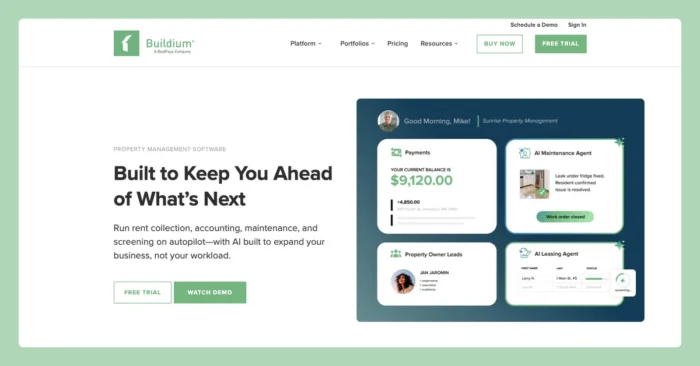
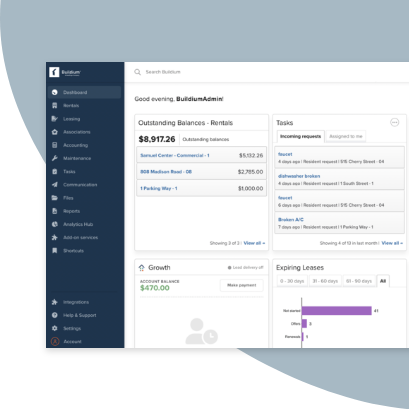
Buildium runs your accounting, leasing, maintenance, and communications on one connected platform, so the money side of the business stays current without double entry. It’s built for a variety of portfolio types and scales with you as you grow. The financials are purpose-built for property management, so owner, vendor, and unit detail is there from the start.
Features
Buildium covers the full accounting workflow so your books stay accurate as you take on more doors.
- Automated accounting and a customizable chart of accounts. Property management accounting records entries as transactions happen and lets you tailor the chart of accounts to how you report.
- Automated bank reconciliation. Buildium matches your bank activity to recorded transactions on every tier, which cuts the manual matching you would otherwise do by hand. Buildium walks through the process in its bank reconciliation post.
- Integrated ePay online payments. Online rent payments post straight to the ledger, so collection and accounting stay in sync.
- Accounts payable and bill pay. Approve, pay, and record owner bills in one place to keep payables and owner statements accurate.
- 1099 e-filing. Track vendor payments through the year and file the forms as an add-on when tax season arrives.
- Trust and fund accounting for associations. Reporting keeps reserve and operating funds separate and audit-ready for community associations.
- Owner portal and reporting. Owners see their own financials through a portal, and you can batch and schedule the reports you send.
- Lumina AI and workflow automations. Automations handle repetitive accounting steps, and the built-in AI assistant helps with communications and analysis.
On top of that, it also has a full suite of other features that cover your operations, from maintenance to marketing.
Pricing
Buildium’s pricing scales based on three tiers:
- Essential: $62/month. Core accounting, maintenance, and leasing, plus basic communications, an AI assistant, and standard and bulk reporting.
- Growth: $192/month. Everything in Essential plus more reporting automation, enhanced tenant screening, lower-cost eSignatures and EFT, and AI-enhanced communications and analytics.
- Premium: $400/month. Everything in Growth plus the most advanced features, free inspections and eSignatures, first-year free incoming EFT, the full AI and automations suite, and Open API.
2. RealPage OneSite
Best for Enterprise-Level Multifamily Property Management Companies
RealPage’s OneSite is a comprehensive property management platform designed specifically for multifamily portfolios at scale, offering a fully integrated, AI-enabled system for operations, leasing, accounting, and resident experience.
It suits enterprise and large multifamily property management companies that need accounting tied into wider operations.
Pricing
RealPage provides customs pricing for each account, so you’ll have to contact them directly for a quote.
3. Propertyware
Best for Single-Family Rental Portfolios
Propertyware focuses on single-family rental management and prices by the unit, which fits scattered-site portfolios spread across many properties. It supports cash or accrual accounting and connects to QuickBooks for teams that keep books there. The per-unit model with monthly minimums can run high for very small portfolios. (Propertyware is a RealPage company.)
Features
Propertyware’s accounting features include:
- Cash or accrual accounting. You choose the accounting basis that matches how you report.
- Customizable fields and reports. Adjust records and reporting to your portfolio’s structure.
- Automated accounts receivable and payable. The system tracks incoming and outgoing money with less manual entry.
- QuickBooks integration. Sync financial data with QuickBooks when your books live there.
- Automated reconciliations. Bank matching runs with less hands-on work.
Pricing
Propertyware has three pricing tiers:
- Basic: $1/unit/month, $250 monthly minimum, with an implementation fee of twice the monthly subscription.
- Plus: $1.50/unit/month, $350 monthly minimum, same 2x implementation fee.
- Premium: $2/unit/month, $450 monthly minimum, same 2x implementation fee.
4. QuickBooks
Best for General Bookkeeping Without Property-Specific Tools
QuickBooks handles general business accounting and covers invoicing, bill pay, and reporting well. However, it is not purpose-built for property management, so it fits owners and managers who want familiar bookkeeping and will track property detail on their own. There’s no owner, tenant, or unit ledgers, and it has no trust accounting, which is where some property managers tend to outgrow it.
Our Buildium vs. QuickBooks post covers the trade-offs.
Features
QuickBooks gives you standard accounting tools that apply to any business.
- Chart of accounts. Set up a general ledger for income and expenses.
- Invoicing. Create and send invoices to track receivables.
- Bill pay. Record and pay bills from within the platform.
- 1099 e-filing. File contractor tax forms directly.
- Automated bank feeds and reconciliation. Import bank activity and match it to recorded transactions.
- Reporting. Run standard financial reports such as profit and loss.
Pricing
- Simple Start: $38/month. Core accounting for a single user.
- Essentials: $75/month. Adds bill pay and more users.
- Plus: $115/month. Adds project and inventory tracking.
- Advanced: $275/month. Adds deeper reporting and support for larger teams.
5. TenantCloud
Best for Smaller Managers and Owners Getting Off Spreadsheets
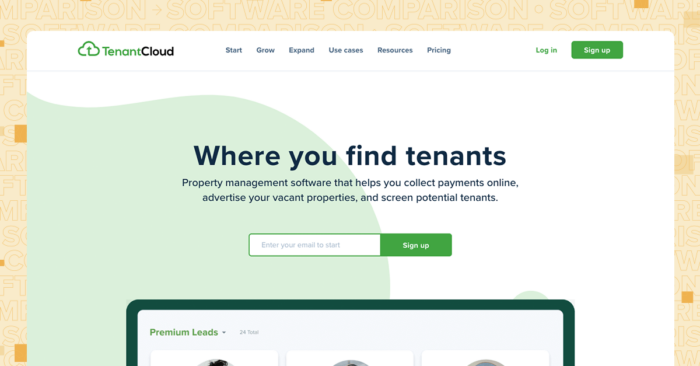
Smaller managers and individual owners moving off spreadsheets are the core users of TenantCloud, which pairs online rent collection with basic accounting reports at a low entry price.
Higher-value accounting are available with the platform’s higher tiers. Bank reconciliation and tax reports arrive only on the Pro plan, and the 1099 form on Growth, which keeps the starting price low, but pushes core accounting up the ladder.
Features
TenantCloud’s core features bundle collection and light accounting for smaller portfolios.
- Online rent payments. Collect rent digitally and track it against tenant records.
- Accounting reports. Run basic financial reports on the entry tier.
- Bank reconciliation. Match bank activity to your records on the Pro tier.
- 1099 tax form. Generate the contractor form starting on the Growth tier.
- Separate owner portal. Give owners their own view on the Pro tier.
Pricing
- Starter: $25/month ($15/month billed annually). Online rent payments, maintenance, listings and applications, and accounting reports.
- Growth: $35/month ($29/month billed annually). Adds enhanced reporting, move-in and move-out inspections, the 1099 tax form, and a message board.
- Pro: $60/month ($50/month billed annually). Adds tax reports, bank reconciliation, a separate owner portal, a lease builder, and QuickBooks sync.
- Business: custom, from $100/month. Adds team management, task management, and interface customization.
6. Building Engines
Best for Commercial Property Portfolios
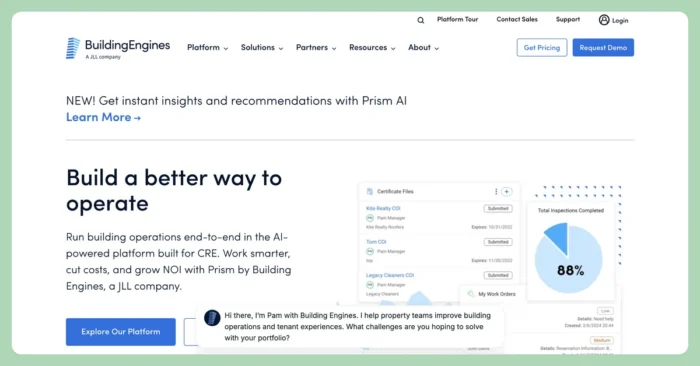
For commercial portfolios across office, retail, and industrial space, Building Engines (Prism) centers on operations and billing. It handles payment dashboards, insurance certificate tracking, and vendor management, which support the financial side of commercial management.
It stops short of full general-ledger accounting, so teams that need double-entry books will pair it with a dedicated ledger.
Features
Building Engines groups its tools around commercial property operations and billing.
- Payment dashboards. Track incoming payments across commercial tenants.
- Certificate-of-insurance tracking. Monitor vendor and tenant insurance compliance.
- Billable services. Bill tenants for services rendered.
- Auto-invoicing. Generate recurring invoices without manual setup each cycle.
- Vendor and bid management. Manage vendors and compare bids in one place.
Pricing
Pricing is not publicly listed. Building Engines provides a custom quote through a form or by phone.
7. ResMan
Best for Multifamily and Affordable Housing Portfolios
ResMan serves multifamily and affordable housing managers, packaging accounting into tiered Levels for conventional and affordable portfolios.
Accounting is included on every Level, along with budgeting, standard and custom reporting, and payments with unlimited ACH and checks. Affordable housing teams get compliance and certification tools for programs such as HUD and Tax Credit. Public pricing is not listed, so plan on a demo to get numbers.
Features
ResMan structures its accounting and compliance tools by portfolio Level.
- Accounting on all Levels. Core accounting is included regardless of tier.
- Budgeting. Build and track budgets across properties.
- Standard and custom reporting. Run built-in reports or configure your own.
- Payments with unlimited ACH and checks. Process payments without per-transaction caps on volume.
- Compliance and certification tools. Support affordable housing programs such as HUD, Tax Credit, and Rural Development.
Pricing
Pricing is not publicly listed. ResMan packages plans into Conventional and Affordable Levels (Start, Scale, and Thrive) and quotes each account through a demo.
8. Rent Manager
Best for Managers Who Want Deep Customization
Managers who want to shape the software around their own workflows benefit the most from Rent Manager, which runs true double-entry accounting on cash and accrual bases at the same time.
The platform offers electronic bank reconciliation, vendor accounts, AI-assisted accounts receivable and payable, and a large library of integrations, with an open API available as an add-on. The depth and customization come with a steeper setup than more out-of-the-box tools.
Features
Rent Manager has more depth and configurability than some of the other options on our list:
- Double-entry accounting. Run cash and accrual bases simultaneously.
- Electronic bank reconciliation. Match bank activity to your records within the platform.
- Vendor accounts. Track vendor balances and payment history.
- AI-assisted accounts receivable and payable. Automate parts of the AR and AP workflow.
- Budgeting. Plan and monitor budgets across properties.
- Integrations and Open API. Connect a large library of outside tools, with an Open API add-on for custom builds.
Pricing
Pricing is not publicly listed. Rent Manager sells Basic, Plus, and Premium bundles and provides a quote on request.
How to Choose the Right Rental Property Accounting Software
Match the software to the portfolio you manage, not the one you might have someday. The right pick comes down to who you serve and how much accounting work you want the platform to carry.
- Single-family, scattered-site portfolios. Per-unit tools such as Propertyware fit when your units are spread across many properties and you want to pay for what you manage.
- Large multifamily or affordable housing. OneSite and ResMan handle high unit volume and program compliance, though both quote custom pricing and take longer to stand up.
- Solo owners and very small portfolios. A point tool such as QuickBooks or TenantCloud covers the basics until manual work starts costing you more than a full platform would.
- Community associations or a mix of rentals and associations. You need trust and fund accounting alongside standard ledgers, which narrows the field to platforms built for both.
For most property management companies, Buildium is an excellent choice. It carries the full accounting workload, handles rentals and community associations in one place, and grows with your door count, which is why it fits more portfolios than any single point tool.
If your needs are narrow and unlikely to change, a specialized pick such as RealPage or Propertyware can serve you well.
If you’re interest in Buildium, and want to see how that works on your own portfolio, you can start a 14-day free trial (no credit card required), or walk through the accounting tools with a guided demo.
Frequently Asked Questions
What Is the Best Accounting Method for Rental Property?
Cash accounting records income and expenses when money changes hands, while accrual records them when they are earned or owed. Cash basis is simpler and works for many smaller portfolios; accrual gives a more accurate picture of performance across a larger operation. Your choice affects your taxes, so confirm the right method with a tax professional before you commit.
Can I Use QuickBooks for Rental Property?
Yes, with limits. QuickBooks handles general bookkeeping such as income, expenses, and 1099 filing, and many owners start there. It does not offer owner, tenant, or unit-level ledgers or trust accounting, so property managers tend to outgrow it once they keep books for multiple owners.
What Features Matter Most in Rental Property Accounting Software?
Focus on automated bank reconciliation, a property-specific chart of accounts with owner and unit ledgers, online rent payments that post to the books, and 1099 e-filing. If you manage community associations, add trust and fund accounting to the list. Those features cover the accounting work that takes the most time by hand.
Buildium’s Commitment to Safe and Secure AI
At Buildium, we believe that AI should be a trusted extension of our platform–not a replacement for human judgement. Our approach to AI is grounded in transparency, education, and rigorous security standards. We deploy AI features with a clear focus: to automate routine tasks while preserving the integrity of sensitive decisions that require human oversight. Lumina AI is built for property managers who value efficiency, security, and trust. We’re not just innovating–we’re doing so responsibly.