

Collecting rent should be one of the more predictable parts of managing rental properties. But when payments come in through different channels, residents need reminders, and owners expect accurate statements, the work can add up quickly.
A good rent collection app takes some of that work off your plate. This guide will help you make the right choice, based on features, transaction costs, how quickly funds arrive, and more.
What we’ll cover:
- Eight rent collection apps at a glance
- Features and pricing for each platform
- How payment fees and accounting tools compare
- What to consider when choosing a rent collection app
- Answers to common questions about collecting rent online
The Best Rent Collection Apps at a Glance
Some rent collection apps are designed for landlords managing a few of their own properties. Others connect payments to owner accounting and broader property management workflows.
Here’s how the eight options compare.
| Platform | Best For | Starting Price | Payment Fees |
| Buildium® | Growing property management companies | $65/month | EFT: $2.35 Essential, $1.35 Growth, free first year on Premium, then $0.60; cards 2.99% |
| TurboTenant® | Self-managing landlords | Free; Essentials from $149/year | ACH $2 on Free and Essentials, typically waived on Pro; cards 3.49% |
| Avail® | DIY landlords | Free; Unlimited Plus $9/unit/month | ACH $2.50 on Free, waived on Plus; cards 3.5% |
| RentRedi® | Independent owners wanting flat-rate pricing | $12/month (billed annually); $29.95/month (billed monthly) | ACH $1; cards 3.1% + $0.30 |
| TenantCloud® | Small rental portfolios | $15/month (Starter, billed annually); $25/month (Starter, billed monthly) | ACH 1.95–1.50 by plan; cards 3.5% + $0.30 |
| Rentec Direct® | Small property management firms | $25/month (Starter, up to 10 properties); $50/month (Pro or PM, rises after first 20–25 units) | Starter: ACH $2, cards 3.5%; Pro/PM: one free incoming ACH per active property monthly, then $0.50; major cards 2.95% |
| Baselane® | Investors who want rent collection and banking together | $0 (Core plan); $20/month (Smart, annual plan) | ACH free into Baselane banking, $2 to external accounts; cards 3.49% |
| Zillow® Rental Manager | Landlords already using Zillow | Free (no subscription) | ACH free; credit cards 2.95%; debit cards $9.95 |
Prices reflect advertised starting rates as of November 2026. Subscription terms, payment fees, and available features vary by plan. Check each provider’s current pricing before subscribing.
Our Take: Free apps work when you manage a handful of units and handle every payment yourself. Once you pay owners every month, reconcile trust accounts, and run a team, you need collection that connects to your accounting. For that kind of business, Buildium is the best rent collection platform on this list.
1. Buildium
Best Overall Rent Collection App for Property Managers
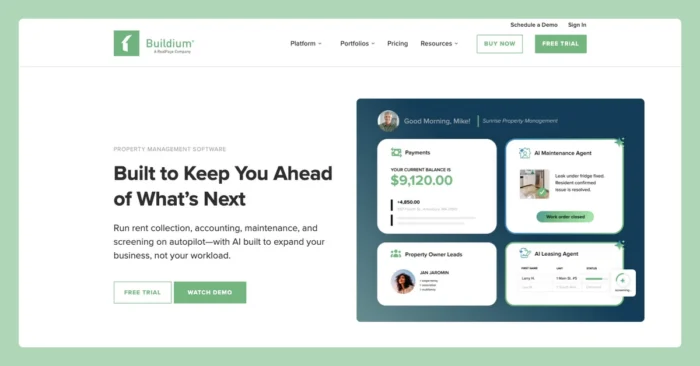
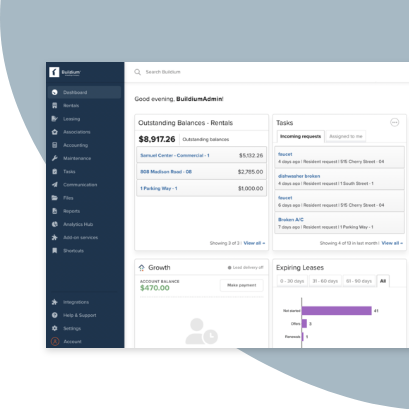
Buildium is property management software built for companies managing rentals and community associations. Its online rent collection tools work alongside property accounting, leasing, and maintenance management.
That connection matters when you’re responsible for client-owned properties. Collecting the payment is just the first step. You also need to record it accurately, reconcile your accounts, and prepare financial information for owners.
Buildium brings those activities into the same platform, reducing the need to move payment information between separate systems.
Features
Buildium combines resident payment options with the accounting and operational tools professional property managers need.
- Online rent payments accept EFT, credit and debit cards, and e-checks, plus cash at 20,000+ PayNearMe retail locations.
- Auto-posting records each payment in the ledger, which cuts payment processing time by up to 70 percent.
- The Resident Center mobile app gives residents autopay and payment reminders, and it’s rated 4.8 stars in the App Store.
- The owner portal gives owners their reports and documents. Buildium records each outgoing EFT to owners and vendors in your books.
- Property accounting includes bank reconciliation and trust accounting reports, so you close the month in the same system that collected rent.
- Automation handles resident payment reminders, returned payments, and bank reconciliation rules. Growth and Premium add workflow automations.
- Buildium AI reconciles bank statements, collects and deposits management fees on a schedule, and helps you write resident communications.
- Customization covers dashboards, user roles, and reports on every plan, custom fields from Growth, and an open API on Premium.
- A marketplace of integrations connects the other tools your team already uses, and it’s included on every plan.
For property managers handling payments for several owners, the main advantage is being able to follow each transaction from resident payment through financial reporting.
Pricing
Buildium offers three subscription tiers, each with a 14-day free trial.
| Plan | Starting Price | Incoming EFT Fee | Key Differences |
| Essential | $65/month | $2.35/payment | Core accounting, online payments, resident and owner portals, and Buildium Assistant |
| Growth | $202/month | $1.35/payment | Adds Workflow Automations, more customization, and business analytics |
| Premium | $420/month | Free for the first 12 months, then $0.60/payment | Adds Open API access, Lumina AI Workforce, and more advanced capabilities |
Credit card processing costs 2.99% on all three plans. Outgoing EFT payments cost $0.99 per transaction.
Buildium bank account setup allowances differ depending on the plan. You can see the full breakdown here.
2. TurboTenant
Best for Independent Owners with up to 50 Units
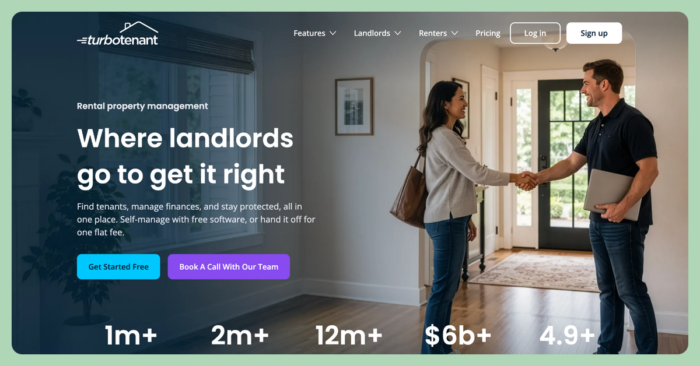
TurboTenant is designed primarily for landlords who manage their own rentals. It offers a free plan that includes online rent collection, with paid subscriptions adding leasing and accounting features.
If you’re handling a few properties yourself, TurboTenant gives you a way to move rent payments online without committing to a monthly software subscription.
Features
TurboTenant focuses on the leasing and payment tasks independent landlords handle regularly.
- Online rent payments: Tenants can pay through ACH, debit cards, or credit cards, with autopay and reminders available.
- Payment tracking: Landlords can view incoming payments, issue receipts, and monitor balances.
- Faster payouts: Essentials and Pro offer expedited processing for eligible ACH payments.
- Rent reporting: Tenants can enroll in rent reporting to help build their credit history, with a separate fee.
- Bookkeeping: Pro adds automated transaction imports, tax-ready reports, and additional bank connections.
TurboTenant also offers rental listings, applications, screening, and maintenance requests, so landlords can manage more than payments in one account.
Its published self-management plans don’t list a dedicated third-party owner portal or trust accounting. Those are important distinctions for professional property managers.
Pricing
TurboTenant has a free plan and two paid annual subscriptions. Paid prices increase with portfolio size.
- Free: $0/month. Includes online rent collection, listings, applications, and maintenance requests. ACH payments cost $2 each.
- Essentials: Starts at $149/year for up to 10 units. Adds online leases, eSignatures, and expedited rent payouts. ACH payments remain $2 each.
- Pro: Starts at $199/year for up to 10 units. Adds more advanced accounting, income verification, and phone support. ACH fees are typically waived.
- Autopilot: A separate full-service rental management option with pricing available directly from TurboTenant.
Card payments carry a 3.49% convenience fee. On Free and Essentials, landlords can choose whether to absorb the ACH fee or pass it to renters.
3. Avail
Best for DIY Owners Who Handle Their Own Leasing
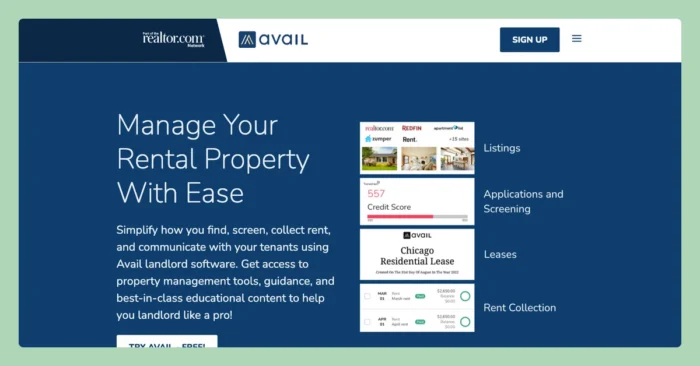
Avail offers a rental platform for small, do-it-yourself owners. It pairs rent collection with listing and leasing tools for people who fill their own vacancies.
Features
Avail’s rent tools focus on recurring payments, deposits, and credit reporting for tenants.
- Recurring payments: Tenants can schedule recurring rent payments with reminders and receipts. You can also collect deposits online.
- Property-specific bank accounts: You can send each property’s rent to its own bank account.
- CreditBoost: Tenants can report on-time rent payments to credit bureaus.
- Payout timing: Avail lists next-day deposits. FastPay, its faster payout option, is limited to Unlimited Plus.
Avail focuses on owners managing their own rentals. Property management companies should check whether its accounting and reporting tools can support finances for multiple clients.
Pricing
Avail has two plans:
- Unlimited: Free for unlimited units. Tenants pay $2.50 per ACH transfer and 3.5% on card payments.
- Unlimited Plus: $9 per unit per month. ACH fees are waived, while card payments remain subject to a 3.5% charge. The plan also adds FastPay and more customization.
Five units on Unlimited Plus cost $45 per month, while 20 units cost $180. Calculate that expense alongside the payment fees you’d otherwise pay on the free plan.
4. RentRedi
Best for Independent Investors Who Want One Flat Rate
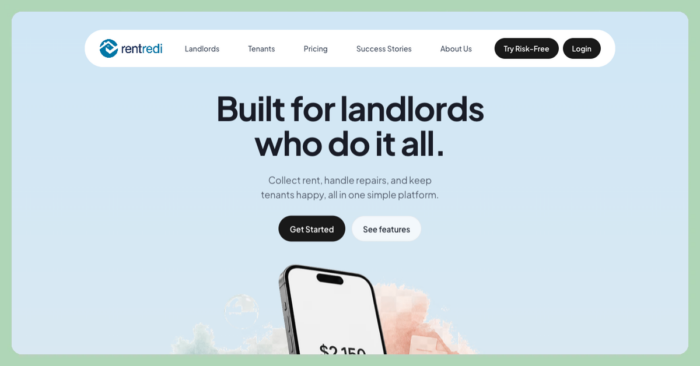
For independent owners and investors, RentRedi offers a mobile-first rental management app. It targets portfolios of any size.
Features
RentRedi gives you payment controls that help when several tenants share one unit.
- Flexible payments: Tenants can make partial or split payments. Apple Pay, Google Pay, and cash are accepted.
- Autopay and reminders: Tenants can set up autopay and get smart reminders.
- Payment block: You can block payments on a tenant’s account.
- Send Money payouts: You can pay owners and vendors from the app. RentRedi doesn’t show a full owner portal or trust accounting.
- Accounting: Includes P&L reports, Schedule E, bank sync, and AI receipt capture. Maintenance runs through a Latchel integration.
Although RentRedi supports payments to owners and vendors, that functionality doesn’t necessarily replace dedicated owner accounting or trust management. Property managers should evaluate those capabilities separately.
Pricing
RentRedi offers one standard subscription with three billing options:
- Monthly: $29.95 per month, billed monthly.
- Six-month: $20 per month, billed as $120 every six months.
- Annual: $12 per month, billed as $144 annually.
All three include the same standard feature set and a 30-day money-back guarantee.
According to RentRedi’s payment fee documentation, ACH payments cost $1 per transaction. Credit and debit card payments cost 3.1% plus $0.30. Landlords can choose to cover these fees rather than pass them to tenants.
5. TenantCloud
Best for Small Portfolios Adding Owner Reporting
Plans at TenantCloud span DIY owners up to small and midsize property management companies. The cloud-based software covers rentals, leasing, and accounting in one account.
Features
TenantCloud covers routine rent collection on every subscription plan.
- Autopay and invoicing: Tenants can set up recurring payments, while landlords create invoices and reminders.
- Payment controls: Landlords can manage partial-payment settings and track outstanding balances.
- Rent reporting: Eligible payments can be reported to credit bureaus.
- Accounting: Income and expense tracking is available across plans, with bank reconciliation and tax reporting on Pro and Business.
- Owner management: Pro adds a separate owner portal, while Business offers broader team management capabilities.
The main limitation to watch is lease capacity. Although TenantCloud supports unlimited properties and units, Starter, Growth, and Pro cap the number of leases you can manage.
Pricing
TenantCloud lists monthly and annual prices for each tier:
- Starter: $25/month, or $15/month billed annually. Includes online rent payments for up to 10 leases; tenants pay $1.95 per ACH payment.
- Growth: $35/month, or $29/month billed annually. Adds a lease builder and inspections for up to 30 leases; ACH is $1.75.
- Pro: $60/month, or $50/month billed annually. Adds the owner portal and bank reconciliation for up to 60 leases; ACH is $1.50.
- Business: Custom pricing starting at $100/month. Adds team management, task management, and customization.
6. Rentec Direct
Best for Small Management Companies Needing Trust Accounting
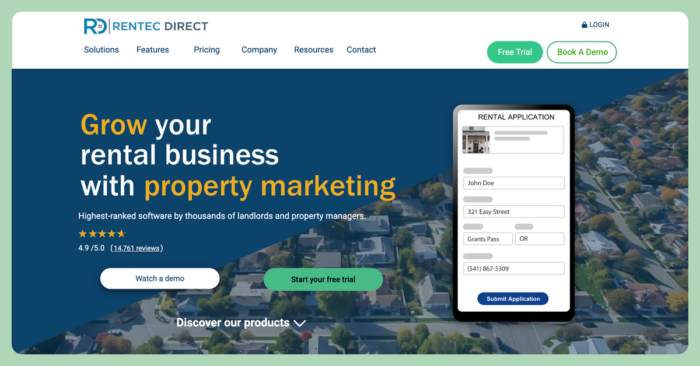
Rentec Direct offers separate software editions for rental owners and property management companies.
Rentec Starter and Pro are geared toward landlords and investors. Rentec PM adds the owner-facing accounting features needed to manage properties for clients.
That makes Rentec PM particularly relevant for property managers who need rent collection connected to trust accounting and owner distributions.
Features
Rentec Direct combines payment collection with property and tenant accounting.
- ACH and card payments: Tenants can pay rent electronically through the tenant portal.
- Cash payments: Eligible Pro and PM users can offer cash payment options through PayNearMe.
- Owner payments: Rentec PM supports electronic distributions to property owners.
- Trust accounting: Rentec PM includes owner accounting, trust-related financial tools, and an owner portal.
- Bank connections and integrations: Pro and PM support more advanced integrations, including API access and bank syncing.
Rentec Direct also supports maintenance management and rental applications.
Pricing
Rentec Direct has three editions and offers a two-week free trial.
- Rentec Starter: $25/month for up to 10 properties and 10 tenants. Incoming and outgoing ACH payments cost $2 each. Most major debit and credit cards cost 3.5%.
- Rentec Pro: Starts at $50/month, subject to unit-based pricing. Includes one free incoming ACH payment per active property each month, with additional payments costing $0.50 each.
- Rentec PM: Starts at $50/month, subject to unit-based pricing. Adds owner portals, trust accounting, and owner distributions.
On Pro and PM, outgoing ACH payments cost $0.50 each. Visa, Mastercard, and Discover payments carry a 2.95% fee, subject to published minimums.
Rentec Direct also offers annual billing discounts.
7. Baselane
Best for Investors Who Want Banking and Rent Together
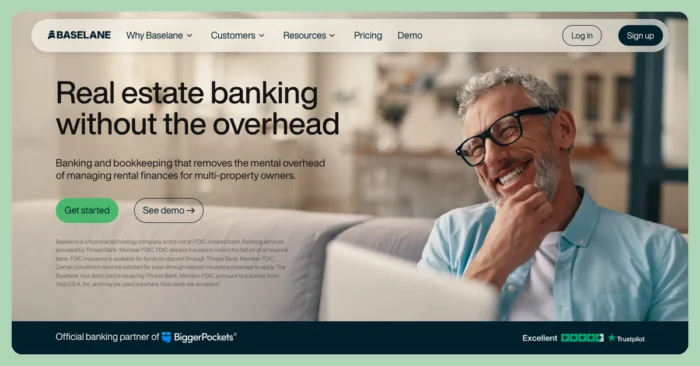
Baselane approaches rental management from a financial perspective. Its platform combines rent collection, banking, and bookkeeping, making it particularly useful for property investors who want their rental finances in one place.
Unlike software built around leasing and maintenance operations, Baselane puts the emphasis on collecting money and organizing transactions.
Features
Baselane connects rent collection to its own bank accounts.
- Banking: Core includes unlimited bank accounts with up to 2.88% APY. FDIC coverage reaches $3 million through Thread Bank.
- Tenant portal and autopay: Tenants can pay through a portal, set up autopay, and split payments. Rent invoices and reminders are included.
- Bookkeeping: Core includes a tenant ledger, rent roll, Schedule E, and QuickBooks and Xero sync. Smart adds AI auto-tagging and receipt matching.
- Payout timing: Two-day rent deposits are a Smart feature only.
- Limitations: Maintenance and leasing tools are limited. There’s no owner portal or trust accounting.
Baselane’s banking tools are geared toward rental investors. If you manage funds for multiple owners, confirm that its account structure and reporting meet your business requirements.
Pricing
Baselane offers two plans:
- Core: Free. Includes rent collection, banking features, and basic bookkeeping.
- Smart: $20/month with annual billing. Adds faster rent deposits, automated transaction categorization, receipt matching, and expanded reporting. A 30-day trial is available.
ACH payments into Baselane banking accounts are free. Payments into external bank accounts carry a $2 fee, which the landlord can absorb or pass to the tenant.
Debit and credit card payments carry a 3.49% fee paid by tenants. Check Baselane’s pricing page for current rates and eligibility details.
8. Zillow Rental Manager
Best for Owners Already Listing Units on Zillow
Zillow Rental Manager offers online rent collection alongside its rental advertising and leasing tools.
It’s designed for landlords who manage their own properties and want a straightforward way to collect payments without paying for a full property management platform.
If you already advertise vacancies through Zillow, keeping rent collection in the same account may be convenient.
Features
Zillow’s payment tools cover the basics independent landlords need.
- Online rent collection: Tenants can pay through ACH, debit cards, or credit cards.
- Recurring payments: Residents can schedule automatic rent payments and receive reminders.
- Payment records: Owners can see payment activity and track when rent is submitted.
- Credit building: Eligible on-time payments can help tenants build credit through Zillow’s reporting program.
- Rental management tools: Zillow also offers listings, applications, and lease-related features.
Zillow Rental Manager is less suited to property management companies that need dedicated owner accounting, trust management, or more extensive operating workflows.
One additional limitation: Zillow’s payment FAQ states that only one renter per property can be set up to pay rent online. That’s worth noting for landlords who regularly collect separate payments from roommates.
Pricing
Zillow doesn’t charge landlords a subscription fee for its standard online rent collection tools.
Its published payment fees are:
- ACH: Free for landlords and tenants.
- Credit cards: 2.95% paid by tenants.
- Debit cards: $9.95 per payment.
Deposits can take up to five business days, depending on the payment method.
How to Choose a Rent Collection App: 5 Things to Consider
The best rent collection app depends on how you manage your properties and what happens after a resident submits payment.
Start with a few questions that can help narrow your options.
1. What Will Online Rent Collection Actually Cost?
A free subscription doesn’t always mean free payments.
Some platforms charge residents for ACH transfers. Others reduce transaction fees when you upgrade to a paid plan. Card payments often carry percentage-based charges regardless of subscription.
Calculate the cost using your actual payment volume.
If you collect 100 ACH payments each month at $2 per transaction, that’s $200 in monthly processing fees, or $2,400 over a year. Depending on who pays those fees, they affect your operating costs or what residents spend to pay rent.
Also check whether fees can be passed through to residents and whether local rules affect that choice.
2. How Easily Can You Track and Reconcile Payments?
Receiving rent is one part of the process. Recording it accurately is another.
Look for software that shows which residents have paid, tracks outstanding balances, and connects payment activity to your accounting records.
If your staff must manually enter transactions into a separate ledger, some of the time saved by collecting rent online disappears.
For more guidance, our rental income accounting tips can help you think through how payments fit into your broader financial process.
3. Do You Manage Properties for Other Owners?
This question changes the software comparison considerably.
Independent landlords may only need to record income and expenses for their own properties. Professional property managers often need separate owner records, trust accounting, and a reliable process for distributing funds.
Buildium and Rentec PM are designed for that kind of work. TenantCloud Pro and Business also offer owner management features, although you’ll want to compare their accounting capabilities in detail.
Trust accounting requirements vary by jurisdiction, so consult a qualified legal or accounting professional about the rules that apply to your business.
4. Will Residents Actually Use It?
Even a capable payment system won’t save much time if residents continue mailing checks or calling your office for basic payment questions.
Look at how easy it is to create an account, set up autopay, and find payment history.
Payment choice matters, too. Some residents prefer a bank transfer, while others need a cash payment option. Buildium supports electronic payments and offers retail cash payment options for residents who need offline alternatives.
A short onboarding guide can help residents make the switch.
5. Can the Software Keep Up with Your Portfolio?
Think about what changes if you add another 50 or 100 units.
Per-unit subscription costs may increase. Some platforms cap the number of leases you can manage, while others reserve important accounting tools for higher tiers.
Also consider whether your team can automate recurring reminders and handle returned payments without adding manual work.
Choose software based on the operation you’re running now, with enough flexibility for the portfolio you’re working toward.
Find the Right Rent Collection App for Your Business
Online rent collection should make life easier for residents and reduce the administrative work your team handles each month. But the best fit depends on whether you’re collecting payments for your own rentals or managing properties for clients.
Keep three things in mind:
- Independent landlords: Free and flat-rate apps can cover everyday payment collection without a large subscription expense.
- Growing portfolios: Compare transaction fees and unit limits before choosing based on starting price alone.
- Property management companies: Look for rent collection that connects to accounting, owner reporting, and distributions.
For property managers handling multiple owners, Buildium brings online rent collection and accounting together. Residents can pay through the Resident Center, while your team tracks payments and manages financial records in one platform.
See how it works with a 14-day free trial or schedule a guided demo to explore the tools with a product specialist.
Frequently Asked Questions About Rent Collection Apps
What Is the Best App to Collect Rent?
The best rent collection app depends on your portfolio and accounting needs.
For independent landlords, TurboTenant, Avail, and Zillow Rental Manager offer free payment collection options. RentRedi is another option if you prefer flat-rate subscription pricing.
For professional property managers collecting rent on behalf of owners, Buildium offers integrated rent collection and property accounting. Rentec PM is another platform worth comparing.
Is There a Free Rent Collection App for Landlords?
Yes. TurboTenant, Avail, Baselane, and Zillow Rental Manager offer free plans or free online rent collection.
However, payment fees may still apply. For example, TurboTenant charges for ACH payments on its Free plan, while Baselane waives those fees when rent goes into a Baselane banking account.
Compare the total cost of collecting rent, not just the software subscription price.
Who Pays the Fees for Online Rent Payments?
That depends on the platform, payment method, and subscription plan.
Tenants commonly pay credit card processing fees. ACH payments may be free, charged to the renter, or covered by the landlord.
Some platforms let property managers choose who absorbs certain transaction costs. Check the applicable rules and each provider’s terms before passing fees to residents.
How Long Do Online Rent Payments Take to Arrive?
Payment timing varies by provider and method. Some platforms offer faster deposits on paid plans, while standard ACH transfers may take several business days.
With Buildium, EFT transactions are typically processed the same day, and banks typically acknowledge the funds the next business day. That doesn’t necessarily mean funds are immediately available.
TurboTenant’s expedited ACH payments generally arrive in two to four business days for eligible transactions. Zillow says deposits can take up to five business days.
If you make owner distributions on a fixed schedule, compare processing time with actual fund availability before switching.
Are Rent Collection Apps Safe to Use?
Reputable rent collection platforms use security measures to protect payment information, but the specific safeguards differ.
Look for encrypted payment processing, secure account access, and compliance with applicable payment security requirements. Two-factor authentication and appropriate staff permissions are also useful protections.
Buildium uses encryption, two-factor authentication, and other safeguards to protect customer information, as outlined in its security documentation.
Avoid storing residents’ bank account or card information in spreadsheets or email, and choose a payment provider with clear security documentation.