

When you manage a small portfolio, rent collection, maintenance calls, lease renewals, bookkeeping, tenant communications all falls on you. The right property management software can take those repetitive tasks off your plate so you can focus on your properties and your residents.
This guide compares five property management software platforms built to lift the burden from landlords and property managers with smaller portfolios. Each option is evaluated on features, pricing, ease of use, and how well it fits the needs of someone managing a handful of doors.
What to Look for in Property Management Software
Before you start comparing platforms, it helps to know which features actually matter for a small operation. Not every tool on the market is built for your scale, and some pack in functionality you will never use while leaving out the basics you need every day.
Online rent collection should be at the top of your list. Look for a platform that accepts multiple payment methods (ACH, credit card, even cash) and lets you set up autopay. The fewer checks you have to chase, the more time you get back. Online rent payments that sync directly with your accounting records are even better.
Tenant screening is another feature worth paying attention to. Effective rental property management software will let you run credit and rental history reports without leaving the system. The faster you can vet an applicant, the faster you can fill a vacancy. Check whether screening costs are passed to the applicant or come out of your pocket.
Maintenance tracking keeps you from losing work orders in a text thread. You want residents to submit requests through the platform, with the ability to assign vendors, track status, and keep a record of every job. If you are fielding maintenance calls on your personal phone, this feature alone can change how your day looks.
Accounting and financial reporting matter more than most owners expect. Property management tools that handle income, expenses, and bank reconciliation in one place save hours at tax time. Look for automated bookkeeping, customizable reports, and 1099 generation.
Ease of use matters more than most owners expect. If the software takes weeks to learn, you will not use it. Good software for small operations works on day one, with a short setup process and an interface that makes sense without a training manual.
Finally, think about pricing and scalability. Some platforms charge per unit, others use flat-rate pricing, and a few offer free tiers. Pick one that fits your budget now but can grow with you as you add more doors.
1. Buildium
Best for a Comprehensive Set of Easy-to-Use Features
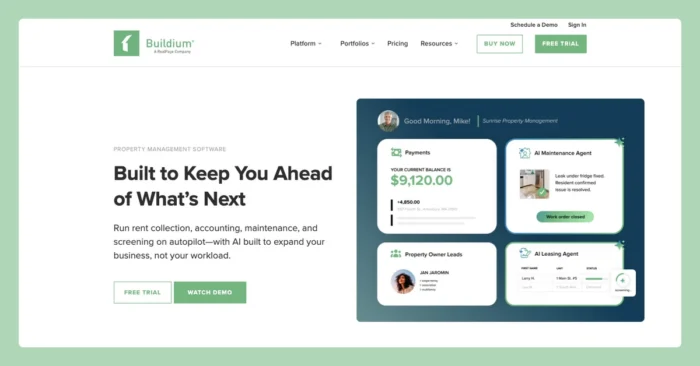
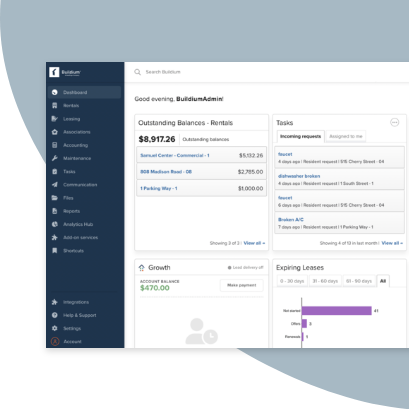
Buildium is an all-in-one property management platform that covers residential, community association, commercial, and student housing properties. It serves property managers across a wide range of portfolio sizes, but its tiered pricing and feature set make it a strong fit for small-to-mid-size operations that want room to grow.
Features
- Online Payments: Buildium’s ePay system accepts ACH, credit card, and cash payments, and it has cut payment processing time by up to 70% for its users. Growth and Premium plan subscribers get free incoming ACH, which means you can collect rent electronically without eating into your margins.
- Accounting Payments: sync directly with the platform’s property accounting tools, so every transaction flows into your books without manual data entry. Automated bookkeeping, customizable financial reports, and 1099 eFiling help keep your records clean and tax season manageable.
- Screening: Tenant screening is built into the platform, letting you run reports and evaluate applicants without switching to a third-party service.
- Communication and Maintenance: Once a resident moves in, the Resident Center app gives them a place to pay rent, submit maintenance requests, and communicate with you directly. On your end, you can assign vendors, track work orders, and keep a full history of every job.
- Leasing: Leasing tools handle everything from listing a vacancy to signing a lease electronically. An owner portal keeps your property owners in the loop with real-time access to financials and reports.
- Integrations: The Buildium Marketplace comes with fully-integrated partner software that targets a wide range of other management tasks, including everything from utility setup to investment management. There’s also an open API that lets you connect the software you’re already familiar with.
These are just some of the main features included in the platform. You can explore more, here.
Pricing
Buildium offers three plans, each with a 14-day free trial and no credit card required to start. All plans include unlimited users, unlimited data storage, and a 95% customer support satisfaction rating.
- Essential (starting at $62 per month): Covers all the basics for accounting, maintenance, and leasing, plus standard reporting and Buildium’s AI assistant. A good starting point if your portfolio is small and your workflows are straightforward.
- Growth (starting at $192 per month): Adds performance analytics, reporting automation, workflow automations, lower-cost eSignatures and EFT transactions, live phone support, and dedicated onboarding. This is the most popular plan.
- Premium (starting at $400 per month): Includes everything in Growth, plus Open API access, the full AI and automations suite, free inspections and eSignatures, and first-year free incoming EFT transactions. Built for operators who are scaling up and want the most control.
If you want a single platform that handles rent collection, screening, accounting, maintenance, leasing, and resident communications, Buildium covers the full range without requiring add-ons.
2. TenantCloud
Best for Budget-Conscious All-in-One Management
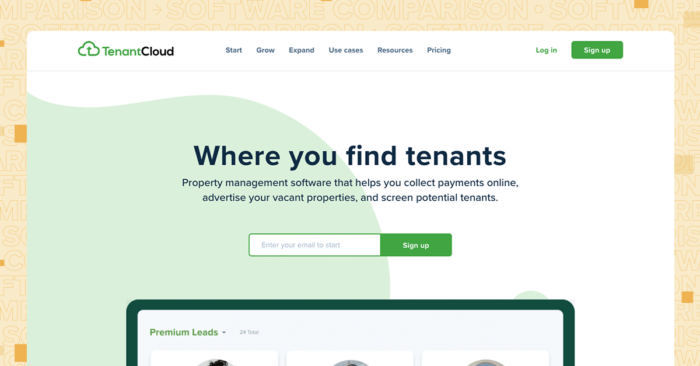
TenantCloud is a cloud-based property management platform that offers a broad set of features at each level, though some capabilities are gated behind higher tiers.
Features
- Online rent collection with ACH and credit card options, plus autopay for tenants
- Tenant screening reports paid by the applicant
- Lease templates with electronic signatures
- Maintenance tracking and work order management
- Listing syndication to rental websites
- Rent reporting to credit bureaus
- Mobile apps for both owners and tenants
Pricing
Here’s a breakdown of TenantCloud’s pricing if you pay monthly:
- Starter: $25 per month (up to 10 leases, 1GB storage)
- Growth: $35 per month (up to 30 leases)
- Pro: $60 per month (up to 60 leases, includes bank reconciliation and owner portal)
The affordable entry point and unlimited property count make TenantCloud appealing for budget-conscious owners managing a handful of doors.
On the downside, lease caps at each tier can feel limiting as your portfolio grows. Storage is capped at 1GB on the Starter plan, bank reconciliation is not available until the Pro tier, and the owner portal is also a Pro-only feature.
3. Landlord Studio
Best for Mobile Bookkeeping and Expense Tracking
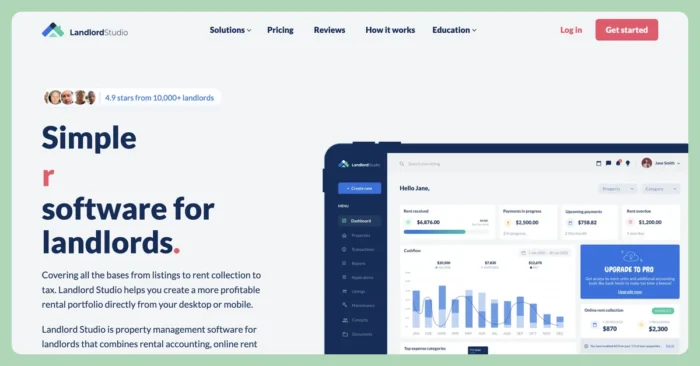
Landlord Studio is a mobile-first platform designed for DIY owners who want simple bookkeeping and property tracking from their phone. The platform has more than 80,000 users.
Features
- Automated bank feeds for transaction matching
- Expense and mileage tracking
- Income and expense reporting for tax preparation
- Online rent collection
- Tenant screening
- Xero integration for advanced accounting
- A well-designed mobile app
Pricing
- GO: Free (limited features)
- Pro: Starts at $12 per month (minimum three units plus $1 per unit from the bas price)
- Max: Starts at $28 per month (minimum three units plus $2 per unit from the base price)
The free tier and strong mobile experience make it a good fit for owners who want straightforward bookkeeping and quick access from their phone.
That said, it is not built for larger portfolios. Owners managing more than 10 doors may find the feature set too limited, and customization options are minimal.
4. RentRedi
Best for Flat-Rate Pricing on Unlimited Units
RentRedi is a mobile-friendly platform with flat-rate pricing and no per-unit fees, which makes it straightforward for owners who want predictable costs as they add doors.
Features
- Online rent collection
- Tenant screening powered by TransUnion
- Listing syndication to Zillow
- Maintenance tracking
- Electronic signatures
- Rent reporting to credit bureaus
- Mobile apps for owners and tenants
Pricing
- Standard: $29.95 per month with unlimited units when paid monthly
- Annual and semi-annual billing options are available at a discount.
The flat-rate model is the main draw: you pay the same whether you manage five units or 50. Zillow listing integration and customizable rental applications add value for owners actively filling vacancies.
The downsides are limited accounting functionality, a tenant portal that is mobile-only, and restricted filtering on financial reports.
5. Avail
Best for First-Time Owners Learning the Leasing Cycle
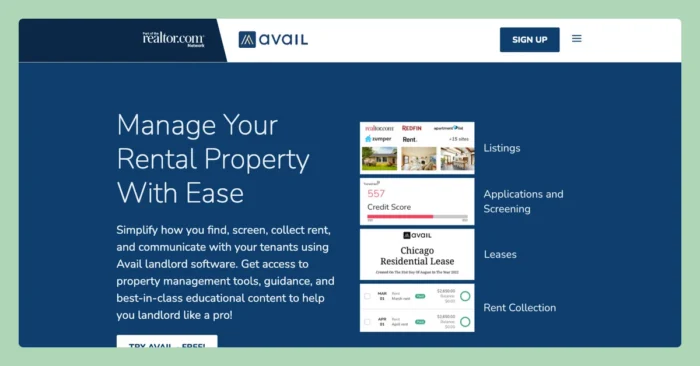
Avail is built for DIY owners who are going through the full leasing cycle for the first time or managing a small number of doors.
Features
- Rental listings with syndication
- Online applications
- Tenant screening (credit and rental history)
- Online leases with electronic signatures
- Online rent collection with a FastPay option
- Maintenance tracking
- Rent price analysis
- Basic property accounting
Pricing
- Unlimited: Free (supports unlimited units)
- Unlimited Plus: $9 per unit per month (adds FastPay, custom lease agreements, and waived ACH fees)
The free plan and guided onboarding make Avail a good entry point for first-time owners who need help getting started. The platform walks you through each step of the leasing process, which is helpful if you are new to managing properties.
The limitation is that some features, including FastPay, are behind the Plus paywall, and the platform does not offer much customization for owners with more complex portfolios.
How to Choose the Right Property Management Software for Your Portfolio
Here are a few questions to work through before you pick a platform:
- How many doors do you manage? Each platform on this list has a sweet spot: some are built for one or two properties, while others are designed to grow with you as you take on more. Picking a tool that matches your current scale saves you from a painful migration later.
- What is your biggest pain point? If rent collection is eating your time, prioritize platforms with strong payment processing and autopay. If you are drowning in receipts and spreadsheets, look for built-in accounting and bank reconciliation. If vacancy turnaround is your bottleneck, focus on screening and leasing tools.
- How do you work? Do you need a mobile app that lets you manage everything from the field? Do you want a desktop-first experience with detailed reporting? Some rental management software is mobile-first by design, while others are stronger on desktop.
- What is the total cost? Free platforms save on monthly fees but may cost you time if they lack the features you need. Per-unit pricing can add up quickly as you grow. Flat-rate plans are predictable but sometimes light on depth. Factor in payment processing fees, add-on costs, and what is included at each tier.
- Have you tested it? Most of the platforms listed here offer a free plan or trial. Load in a few properties, run through your daily workflow, and see if the software actually makes your day easier.
Among the options on this list, Buildium handles rent collection, accounting, screening, maintenance, and leasing in a single platform, which makes it worth trying if you want one tool that covers all of those areas.
The Right Property Management Software Makes All the Difference
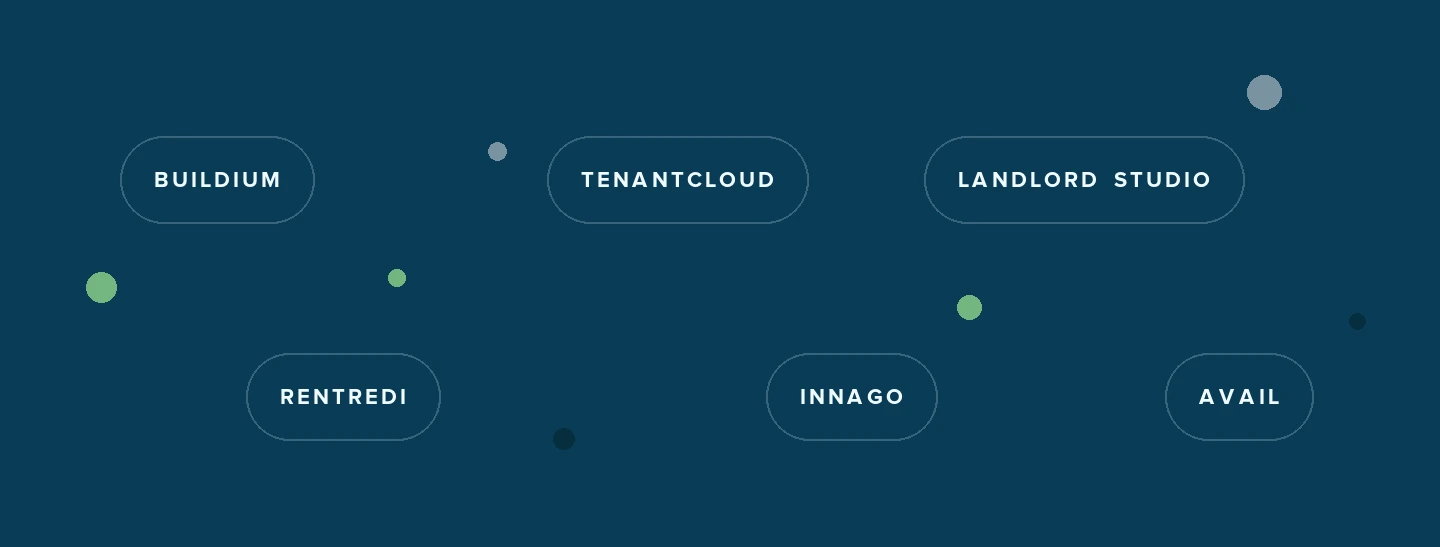
Each of the six platforms in this article brings something different to the table, and the right fit depends on your portfolio size, budget, and goals. The right property management software takes the repetitive, time-consuming work off your hands so you can spend more time on the parts of the job that actually grow your business.
Buildium is designed to handle all your tasks in one place, with the depth and flexibility to grow alongside your portfolio.
To see how Buildium can help you manage your portfolio, you can sign up for a 14-day free trial or schedule a guided demo.
Frequently Asked Questions
What Is the Best Property Management Software for a Small Portfolio?
The right choice depends on your needs and budget. Buildium, TenantCloud, and RentRedi all offer strong feature sets for small portfolios. Buildium handles rent collection, accounting, screening, maintenance, and leasing in one platform, making it a good fit if you want a single tool for everything. TenantCloud and Landlord Studio are solid options if you are looking for a lower entry price.
Is There Free Property Management Software That Works for Small Operations?
Yes. Innago is completely free with no monthly fees or contracts. Avail offers a free plan with unlimited units, though some features require the paid Plus tier. Landlord Studio also has a free GO plan with limited functionality. Each of these can work for owners with a small number of doors, though free platforms tend to have trade-offs in speed, depth, or scalability.
What Features Matter Most When You Only Manage a Few Properties?
Focus on the basics: online rent collection, accounting and expense tracking, maintenance request management, and tenant screening. These four functions cover the tasks that take up the most time for small-portfolio owners. Ease of use matters too. If the software is complicated to set up or navigate, you will not stick with it.
Can Property Management Software Help with Tenant Screening?
Yes. Most property management platforms include built-in tenant screening or integrate with third-party services. Screening typically covers credit history, rental history, and identity verification. Some platforms pass the screening cost to the applicant, while others include it in your subscription. Having screening inside your management platform saves you from toggling between systems during the application process.
Buildium’s Commitment to Safe and Secure AI
At Buildium, we believe that AI should be a trusted extension of our platform–not a replacement for human judgement. Our approach to AI is grounded in transparency, education, and rigorous security standards. We deploy AI features with a clear focus: to automate routine tasks while preserving the integrity of sensitive decisions that require human oversight. Lumina AI is built for property managers who value efficiency, security, and trust. We’re not just innovating–we’re doing so responsibly.