

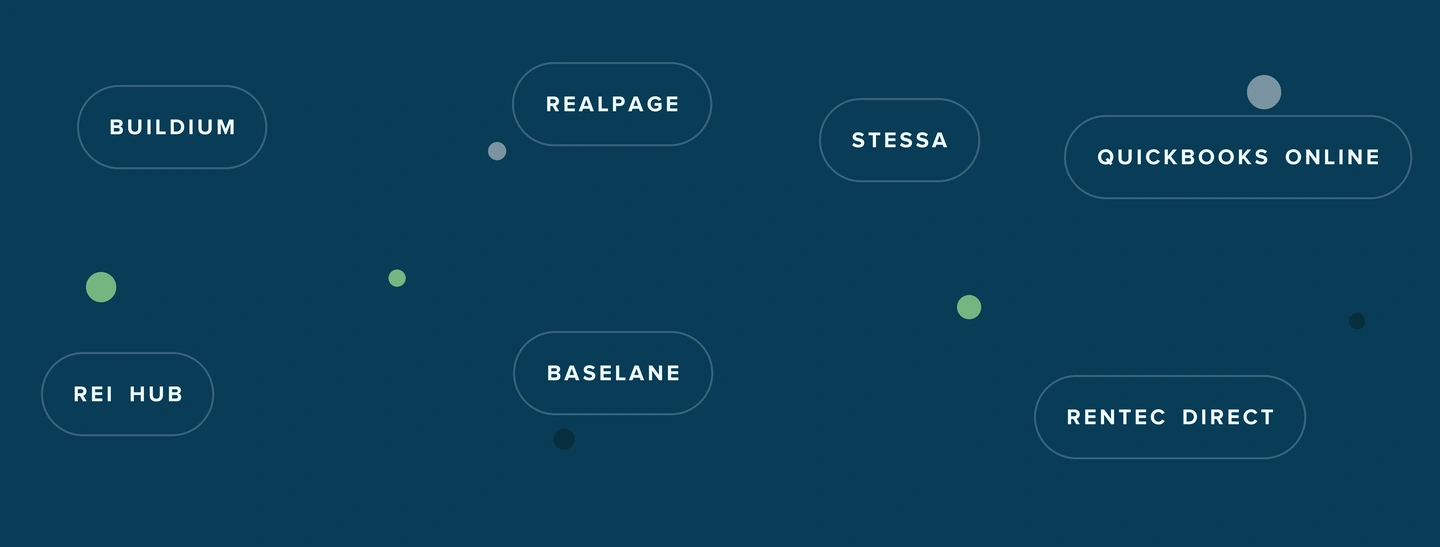
Managing rental income, depreciation schedules, and tax prep across multiple properties calls for accounting tools built for real estate. General-purpose bookkeeping software can work, but property investors often benefit from tools with property-level tracking, tax-ready reports, depreciation support, or rent collection built in. Below, we review seven platforms for property investors at every portfolio size.
What we’ll cover:
- A side-by-side comparison table of all seven platforms
- How to choose the right accounting software for your portfolio
- Frequently asked questions
At-a-Glance Comparison
| Platform | Starting Price | Free Trial | Best For |
|---|---|---|---|
| Buildium® | $62/month (Essential, billed monthly) | 14-day free trial | Property managers handling owner accounting |
| RealPage® | Custom pricing | N/A | Enterprise-scale portfolios |
| Stessa® | $15 (Managed plan, billed monthly) | N/A | Investors tracking a few properties |
| QuickBooks Online® | $38/month (1 user, 2 accounts max) | 30-day free trial | Investors whose CPA uses QuickBooks |
| REI Hub® | $15 (up to 3 units plan, billed monthly) | 14-day free trial | DIY investors wanting rental bookkeeping |
| Baselane® | $20 (Smart plan) | 30-day trial (Smart tier) | Investors wanting banking plus bookkeeping |
| Rentec Direct® | $50/month (PM and Pro plans, billed monthly) | 2-week free trial | Landlords and smaller management companies |
Our Take
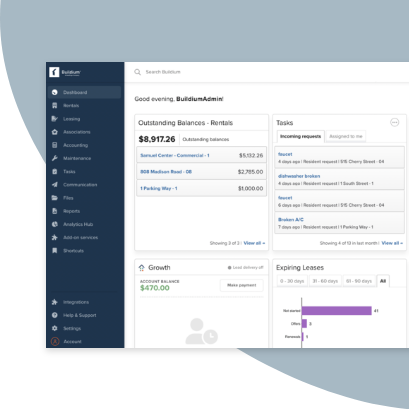
Property managers and investors who want accounting, leasing, maintenance, communication, and reporting in one platform should start with Buildium. It covers core property management workflows, including online payments, accounting, maintenance, owner reporting, leasing tools, and 1099 eFiling.
For larger portfolios and managers looking for a wider range of investing-specific capabilities, RealPage is another strong option. Investors with smaller portfolios and tighter budgets should look at Stessa or REI Hub, both of which offer free tiers.
1. Buildium
Best for Investors and Property Managers Who Want Accounting Plus Operations
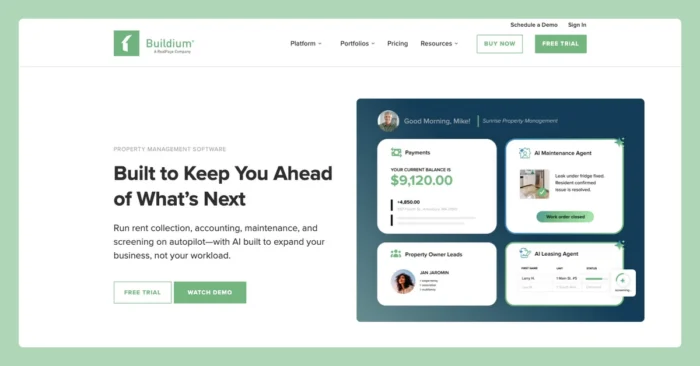
Buildium is a property management platform that combines accounting, leasing, maintenance, payments, reporting, and communications in one system. It is a strong fit for property investors who actively manage growing portfolios, as well as property managers handling rentals on behalf of owners.
Because accounting sits inside the broader property management workflow, financial data can stay connected to leases, tenants, properties, payments, and owner reporting with less manual transfer between systems.
Features
Buildium’s accounting capabilities cover the core financial workflows that property investors and property managers deal with regularly. Here is what the platform includes:
- Property management accounting: Manage general ledger activity, accounts payable, accounts receivable, vendor payments, owner payments, and property-level financial reporting in a system built specifically for property management.
- Bank reconciliation: Connect bank accounts, import transactions, and match them against recorded activity to reduce manual reconciliation work.
- Trust accounting support: For property managers who hold funds on behalf of owners, Buildium supports trust-account workflows and reporting that can help teams separate owner, tenant, and operating funds.
- 1099 eFiling: Generate and file 1099s online at year-end directly from within the platform.
- Online rent payments through ePay: Tenants can pay rent online through EFT/ACH and credit card payments. Property managers can configure certain processing or convenience fees where permitted, but rules vary by jurisdiction and payment type.
- Owner and tenant portals: Online portals give property owners access to financial reports and statements, while tenants can submit payments, view balances, and communicate with management.
- Agentic AI: Buildium’s AI-supported tools can help with repetitive work across communications, billing, maintenance, leasing, reporting, and internal workflows, while keeping staff in control of review and follow-up.
Beyond accounting, Buildium also handles tenant screening, leasing, maintenance tracking, and communications, making it a single platform for the full property management workflow.
Pricing
- Essential: Starting at $62/month
- Growth: Starting at $192/month
- Premium: Starting at $400/month
To learn more about plan features, pricing, visit Buildium’s pricing page.
2. RealPage
Best for Institutional-Scale Property Management
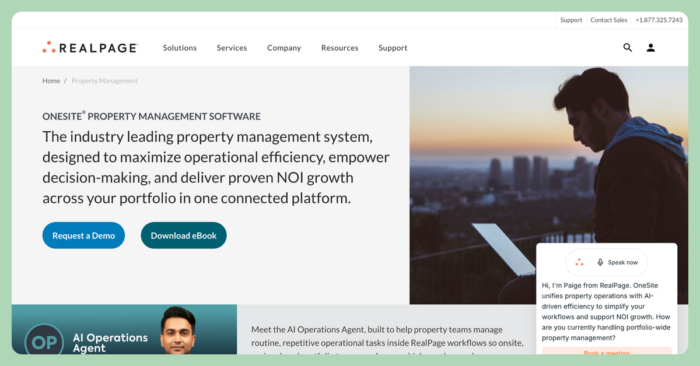
RealPage offers enterprise property management and accounting software for large property management organizations and institutional portfolios. Its financial tools are designed for teams that need connected property accounting, corporate accounting, budgeting, forecasting, reporting, spend management, and portfolio-level visibility.
The platform is a stronger fit for large operators than for individual investors or small landlords, with features built for organizations that have complex accounting structures, multiple properties, larger teams, and more formal implementation needs.
Features
- Property and corporate accounting: Manage back-office accounting workflows across properties, entities, and portfolios, with tools for property accounting, corporate accounting, and financial close.
- Budgeting and forecasting: Build budgets, reforecast performance, consolidate financial data, and create reports without relying on disconnected spreadsheets.
- Financial reporting: Generate portfolio-level and stakeholder-facing reports to support owners, investors, executives, and accounting teams.
- Spend management: Connect purchasing, payables, and spend activity with broader financial workflows.
- Job cost accounting: Track project-related costs for capital work, renovations, or other property-level projects.
- Integrated property operations: Connect accounting with property management workflows such as leasing, maintenance, documents, and resident or tenant activity.
- Open platform architecture: Connect RealPage with other systems and services through its broader platform and integration ecosystem.
Pricing
Custom pricing based on portfolio size, products selected, and implementation needs. Contact RealPage directly for a quote
3. Stessa
Free Accounting Tool for Small Portfolios
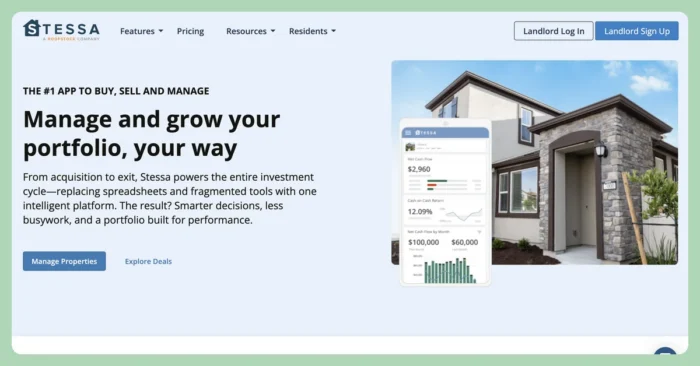
Stessa is a financial tracking platform designed specifically for real estate investors. It offers a free Essentials plan with unlimited properties, making it a practical starting point for landlords who want organized income and expense tracking without a monthly subscription.
Features
- Automatic transaction imports: Connect bank and credit card accounts to import transactions and categorize income and expenses by property.
- Property-level financial reports: View income statements, cash flow reports, and net operating income at the individual property level.
- Schedule E reports: Export Schedule E-formatted reports for tax prep on Manage and Pro plans.
- Maintenance expense tracking: Track maintenance-related expenses and records by property. For work orders, vendor dispatch, and tenant-facing maintenance workflows, investors may need a broader property management platform.
- Budgeting and advanced reporting: Set property-level budgets and access more detailed analytics on higher-tier plans.
Pricing
All plans include unlimited properties, and annual billing lowers the price of paid plans by 20%, according to Stessa’s published pricing details.
- Essentials: Free, with bank feeds, rent collection, a basic tax package, and five receipt scans per month.
- Manage: $15/month billed monthly or $12/month billed annually, adding the Schedule E report and faster rent payments.
- Pro: $35/month billed monthly or $28/month billed annually, adding unlimited receipt scans, budgeting, and multiple portfolios.
4. QuickBooks Online
General Accounting Software for Property Investors
QuickBooks Online is a general-purpose accounting platform, not software built specifically for real estate. Many property investors use it because of its broad CPA compatibility, flexible chart of accounts, familiar reporting tools, and large ecosystem of integrations.
The tradeoff is setup. QuickBooks can work for rental property accounting, but it requires more manual configuration for property-level tracking, Schedule E reporting, depreciation records, and owner-level reporting than purpose-built real estate tools.
Features
QuickBooks Online provides general accounting tools that can be adapted for rental property use:
- Bank syncing and expense tracking: Connect bank accounts to import transactions, categorize expenses, and review financial activity. Rules can help categorize recurring transactions, but property-level tracking usually requires a thoughtful setup using classes, locations, customers/projects, tags, or a customized chart of accounts.
- Invoicing and payment tracking: Create invoices, accept payments, and track payment status from the platform.
- Customizable chart of accounts: Set up accounts, classes, locations, or other tracking structures to separate income and expenses by property.
- Mileage tracking: Track mileage for property-related travel through the QuickBooks mobile app.
- Third-party integrations: QuickBooks connects with a large app ecosystem, including many property management, rent collection, payroll, payment, and reporting tools.
Pricing
Quickbooks Online lists a few tiered pricing plans:
- Simple Start: $38/month, for one user plus two accountants.
- Essentials: $85/month, for three users plus two accountants, with more detailed reports.
- Plus: $140/month, for five users plus two accountants, adding budgets and up to 40 classes or locations.
- Advanced: $340/month, for 25 users plus three accountants, adding unlimited classes and locations.
New customers can typically choose between a 30-day free trial and an introductory discount and prices are discounted if you pay by quarter. Since promotional offers change, check current pricing and terms before choosing a plan.
5. REI Hub
DIY Rental Property Bookkeeping
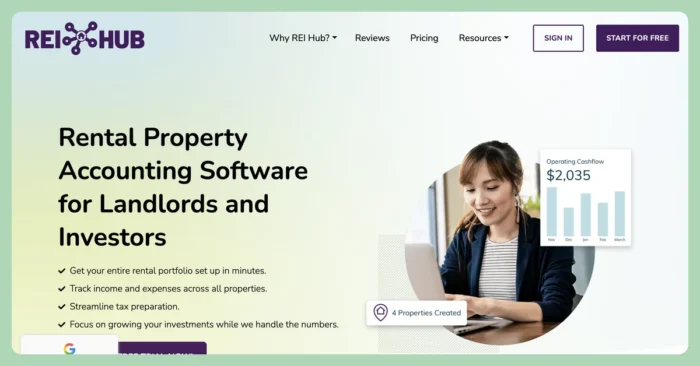
REI Hub is an accounting platform built from the ground up for rental property investors. It uses a real estate-specific chart of accounts and double-entry accounting system, so the categories and reports align with how landlords manage income, expenses, assets, and tax preparation.
Features
- Real estate-specific chart of accounts: Use pre-built categories for rental income, property expenses, assets, and other real estate bookkeeping needs, so landlords do not need to build a chart of accounts from scratch.
- Double-entry accounting: Record transactions using double-entry bookkeeping for more accurate financial records and reporting.
- Schedule E reports: Generate Schedule E reports for each property to support tax preparation.
- Bank syncing: Connect bank accounts to import and categorize transactions automatically.
- Fixed asset and depreciation tracking: Track fixed assets, capital improvements, basis, accumulated depreciation, and recommended annual depreciation entries. REI Hub does not automatically record depreciation entries, so users should review entries with a CPA or tax preparer.
- Document storage: Upload and organize receipts, invoices, and other financial documents alongside related transactions.
Pricing
- Free: Up to 3 units, with limited features.
- Professional: Priced at $9/month billed annually or $15/month billed monthly. Higher tiers are available for larger portfolios, including unlimited-unit pricing.
6. Baselane
Banking-First Rental Bookkeeping

Baselane combines banking, bookkeeping, rent collection, and reporting in one platform for landlords and real estate investors. Its free Core plan includes banking and basic bookkeeping tools, which can reduce the need to manage separate bank accounts and accounting software for smaller portfolios.
Features
Baselane’s approach connects banking directly to bookkeeping:
- Banking with property-level accounts: Open dedicated checking and savings accounts for properties or entities. Savings balances may earn a variable APY, with the highest advertised rate depending on balance tiers and eligibility requirements.
- Debit cards with spend tracking: Use physical or virtual debit cards with spend controls and transaction tagging to keep property expenses organized.
- Property- and entity-level bookkeeping: Track income, expenses, assets, liabilities, and equity by property or entity, with categorization tied to banking transactions.
- Rent collection: Collect rent online with tenant-facing payment options.
- Schedule E reports: Generate Schedule E reports by property and entity to support tax preparation.
- AI auto-tagging and receipt matching: On the Smart plan, Baselane can categorize transactions and match uploaded receipts to expenses automatically.
- Cost segregation and depreciation tracking: On the Smart plan, track fixed assets, reclassify property components, and set custom depreciation schedules. Investors should confirm depreciation treatment with a CPA or tax advisor.
Pricing
- Core: Free plan with banking, basic bookkeeping, and rent collection tools.
- Smart: $20/month, with additional bookkeeping, automation, and reporting features.
7. Rentec Direct
Best for Smaller Operators Who Need Trust Accounting Tools
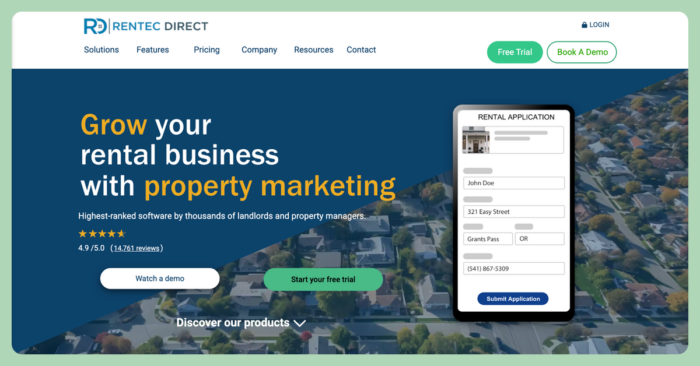
Rentec Direct offers property management and accounting tools for landlords and property managers. Rentec Pro is designed for landlords or building managers who manage their own rentals, while Rentec PM adds owner accounting, trust accounting support, and an owner portal for professional property managers.
Features
- Property, tenant, and bank accounting: Track income and expenses by property and tenant, sync bank transactions, and manage accounting records in the platform.
- Bank reconciliation: Match imported transactions against recorded entries to keep records accurate.
- 1099 eFiling: Prepare 1099 reports and electronically file 1099-MISC and 1099-NEC forms through Rentec Direct’s Nelco integration. Filing fees may apply.
- Schedule E reports: Export Schedule E tax reports to support rental property tax preparation.
- Online rent payments: Tenants can pay online, including free tenant ACH payments. Other payment methods may carry fees.
- Tenant screening: Run credit, criminal, and eviction checks directly from the platform.
- Trust accounting tools: Rentec PM supports trust accounting and owner accounting for property managers who hold funds on behalf of owners. Requirements vary by state, so teams should confirm their processes with qualified accounting or legal professionals.
Pricing
Rentec Direct offers three plans:
- Rentec Starter: $25/month but only available for up to 10 properties, with core accounting, reporting, online rent payments, and tenant management.
- Rentec Pro: $50/month for the first 20 units and adds tools such as bank sync, 1099 eFiling, QuickBooks sync, API access, and Zapier integrations.
- Rentec PM: $50/month for the first 20 units and adds owner management, ACH owner payments, and trust accounting.
Pro and PM pricing increase with unit count and annual billing discounts are available.
Frequently Asked Questions
What Is the Best Accounting Software for Rental Property?
The answer depends on your portfolio size and management style. Buildium is a strong fit for property managers who want accounting integrated with leasing, maintenance, and tenant communications. Stessa works well for solo landlords who need free, real estate-specific tracking. QuickBooks Online is a solid option for investors who want CPA-friendly flexibility and are willing to customize the setup for property-level tracking.
Do Property Investors Need Specialized Accounting Software?
General accounting tools can track income and expenses, but they typically lack real estate-specific features like Schedule E reports, property-level profit and loss statements, cash-on-cash return calculations, and trust accounting. Specialized software saves time by automating these reports and organizing data in a format that aligns with how rental properties are taxed and managed.
Can I Use QuickBooks for Rental Property Accounting?
Yes, QuickBooks Online can be used for rental property accounting, but it requires manual setup. You will need to create a custom chart of accounts for each property, and the platform does not generate real estate-specific reports like Schedule E without additional configuration or third-party integrations. Many investors pair QuickBooks with a property-specific tool like Stessa or Rentec Direct for a more complete workflow.
What Accounting Features Should Property Investors Look For?
At a minimum, look for income and expense tracking at the property level, bank reconciliation, and tax-ready reports (especially Schedule E). Rent collection, 1099 eFiling, and owner reporting are important for property managers handling units for other investors. If your portfolio is growing, consider platforms that also offer trust accounting, maintenance tracking, and integrations with other tools you use.
Buildium’s Commitment to Safe and Secure AI
At Buildium, we believe that AI should be a trusted extension of our platform–not a replacement for human judgement. Our approach to AI is grounded in transparency, education, and rigorous security standards. We deploy AI features with a clear focus: to automate routine tasks while preserving the integrity of sensitive decisions that require human oversight. Lumina AI is built for property managers who value efficiency, security, and trust. We’re not just innovating–we’re doing so responsibly.