


Note: Reviews, pricing, and product details are up-to-date as of September 1, 2026. For the latest information, reach out to the platform provider and check review sites directly.
At first glance, Yardi Breeze might check a lot of the right boxes. Accounting, leasing, payments, maintenance, and resident tools are all there. The real question is how well the platform fits once you factor in pricing minimums, plan differences, and the way your portfolio is likely to grow.
This review takes a closer look at the features, pricing, pros, and limitations that matter most, so you can see where Yardi Breeze fits (and where it may not).
What we’ll cover:
- Yardi Breeze at a glance and who it’s best for
- The platform’s accounting, leasing, maintenance, and portal features
- Yardi Breeze pricing, monthly minimums, and plan differences
- The main pros, cons, and limitations to weigh
- How Yardi Breeze compares with Buildium
Yardi Breeze at a Glance
Yardi Breeze is a cloud-based property management platform for residential and commercial portfolios. It combines accounting, leasing, payments, maintenance, and owner tools in one system, with Breeze Premier adding more advanced financial controls, CRM features, and support for additional property types.
| Category | Details |
|---|---|
| Best For | Small and midsize residential or commercial property managers that want built-in accounting and a more self-contained system |
| May Not Be Ideal For | Teams that need broad third-party integrations, deeper customization, or more advanced reporting on the base plan |
| G2 Rating | ~4.1/5 based on 362 reviews
Review Snapshot: “Robust Accounting Features, Needs Streamlined Maintenance System” – Matthew E. |
| Capterra Rating | ~4.2/5 based on 334 reviews
Review Snapshot: “Breeze is good, but needs simple improvements.” – Brien S. |
| Starting Price | Residential Breeze starts at $1/unit/month with a $100 monthly minimum |
| Free Trial | No traditional free trial |
Our Take: Yardi Breeze offers a capable core platform with particularly strong accounting and commercial-property tools. The main trade-offs are its monthly minimums, more self-contained ecosystem, and the amount of added functionality reserved for Breeze Premier.
Who Yardi Breeze Is Best For?
Yardi Breeze makes the most sense for teams that want property accounting and day-to-day management tools inside a relatively self-contained Yardi environment. Standard Breeze covers residential and commercial portfolios, while Premier opens the door to affordable housing, associations, manufactured housing, and self-storage.
Teams that rely heavily on outside integrations, want to test the software before committing, or need more advanced automation may want to compare alternatives.
Yardi Breeze vs. Buildium: How Do They Compare?
Yardi Breeze and Buildium both cover the core workflows property managers need, but they take different approaches to pricing, portfolio support, integrations, and how advanced features are packaged.
| Feature | Yardi Breeze | Buildium |
|---|---|---|
| Starting price | Residential starts at $1/unit/month with a $100 monthly minimum | Starts at $62/month |
| Free trial | No traditional free trial; 30-day cancellation option | 14-day free trial, no credit card required |
| Portfolio support | Residential and commercial; Premier adds affordable housing, associations, manufactured housing, and self-storage | Residential, community associations, and mixed portfolios |
| Accounting | Built-in property accounting; Premier adds more advanced reporting and financial controls | Property accounting, bank reconciliation, owner reporting, and 1099 e-Filing |
| Integrations | More self-contained within the Yardi ecosystem | Buildium Marketplace integrations |
| API access | Not positioned as a core Breeze capability | Open API on Premium |
| AI and automation | Smart AP and other advanced tools on Premier | Buildium AI and automation tools across plans, with the most advanced capabilities on Premium |
| Support and onboarding | Setup and training included, with live chat, phone, and email support | Ticket support on all plans, live phone support on Growth and Premium, Priority Support on Premium |
Where Yardi Breeze Stands Out
Yardi Breeze is a strong fit for teams that want a more self-contained system and published per-unit pricing. It also has an edge for commercial portfolios, with tools such as CAM recovery, lease tracking, percentage rents, and other commercial workflows built into the platform.
Breeze Premier also broadens the portfolio mix with support for affordable housing, associations, manufactured housing, and self-storage.
Where Buildium Stands Out
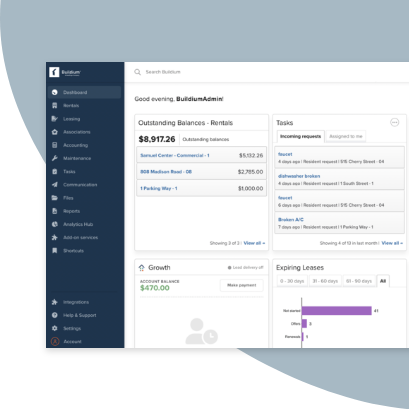
Buildium gives property managers more flexibility around portfolio size, integrations, and how they adopt more advanced tools over time. Teams can also test the platform before committing.
A few other differences stand out:
- No unit minimum: Smaller teams can start with the portfolio they have today without meeting a minimum door count.
- More pricing visibility: Essential, Growth, and Premium pricing is published upfront, which makes it easier to compare costs before talking with sales.
- Broader integration options: Buildium Marketplace connects outside tools, while Premium adds Open API access for teams that need more customized connections.
- AI and automation: Lumina AI and automation tools help reduce repetitive work across communications, accounting, leasing, maintenance, and reporting.
- Association support without a separate Premier minimum: Buildium supports rental portfolios and community associations within the same plan structure.
- Free trial: The 14-day trial gives teams a chance to work in the platform before making a purchase decision.
For property managers who want published pricing, no unit minimum, broader integration flexibility, and room to add more advanced automation over time, Buildium may offer the stronger all-around growth path.
Yardi Breeze Features That Matter Most
Yardi Breeze covers the everyday property management basics, but a few capabilities stand out more when you’re comparing it with other platforms:
- Built-in property and corporate accounting: Breeze includes property accounting, trust and escrow tracking, budgeting, financial statements, and 1099 e-filing. Breeze Premier adds corporate general ledgers, customizable financial statements, batch processing, and job cost tracking.
- Commercial CAM recovery: Commercial portfolios can manage NNN and gross leases, build custom expense pools, allocate CAM charges, and handle recurring reconciliations.
- RentCafe ecosystem: Yardi connects leasing and resident workflows with RentCafe, including listing exposure, online applications, payments, maintenance requests, and resident access.
- Broader specialized-property support on Premier: Breeze Premier expands beyond standard residential and commercial portfolios to affordable housing, associations, manufactured housing, and self-storage, with workflows tailored to those property types.
- More advanced workflow controls on Premier: CRM queues, move-in and move-out workflows, invoice processing, menu-level security, and more detailed reporting give larger or more specialized teams additional control.
Yardi Breeze Pricing
Yardi Breeze uses per-unit pricing with monthly minimums that vary by property type. Contracts are based on annual agreements, and Yardi does not charge separate onboarding, training, or support fees. The full breakdown is on the Yardi Breeze pricing page.
Breeze
- Breeze (residential): $1 per unit per month with a $100/month minimum. Covers accounting, marketing, leasing, online payments, and maintenance.
- Breeze (commercial): $2 per unit per month with a $200/month minimum, with the same core tools set up for commercial portfolios.
Breeze Premier
- Residential: $1/unit/month, with a $400 monthly minimum. Terms and minimums apply.
- Affordable housing: $3/unit/month, with a $400 monthly minimum.
- Associations: $1/unit/month, with a $400 monthly minimum.
- Commercial, self-storage, and manufactured housing: Contact Yardi for pricing.
Because each plan has a monthly minimum, smaller portfolios may pay more than the advertised per-unit rate. For example, a 20-unit residential Breeze portfolio would still pay the $100 monthly minimum, or an effective $5 per unit.
Final Takeaways: Yardi Breeze Pros and Cons
Yardi Breeze Pros
- Strong accounting foundation: Property accounting, budgeting, financial statements, trust and escrow tracking, and 1099 e-filing cover the core financial workflows most property managers need.
- Straightforward day-to-day experience: Reviewers frequently praise the interface, navigation, and ease of completing routine tasks.
- Useful commercial tools: CAM recovery, lease tracking, percentage rents, and other commercial features give Breeze more depth for mixed residential and commercial portfolios.
- Broader property support on Premier: Breeze Premier adds workflows for affordable housing, community associations, manufactured housing, and self-storage.
- No separate setup, training, or support fees: Yardi includes those services without charging separate fees.
Yardi Breeze Cons
- Reporting and customization limits: Reviewers commonly flag reporting depth and flexibility as weaker points, especially for more complex workflows.
- More advanced features sit on Premier: Custom financial reporting, deeper accounting controls, CRM tools, and specialized property workflows require the higher-tier product.
- Monthly minimums can raise the effective cost: Smaller portfolios may pay well above the advertised per-unit rate.
- More self-contained ecosystem: Teams that rely heavily on outside tools may find fewer integration options than they want.
- No traditional free trial: Yardi does not advertise a standard free trial, though contracts include a 30-day cancellation option.
Choosing the Right Property Management Software for Your Portfolio
Yardi Breeze is a reasonable fit for small residential operators who want published per-unit pricing and core tools on one platform. Managers who expect to grow, want to test software before committing, or run community associations alongside rentals may find Buildium’s published pricing, broader integration options, and association support a closer match.
The right choice comes down to your portfolio mix, your budget, and how much reporting depth and integration flexibility you need.
If you want to test Buildium out for yourself to see if it’s a better fit for your portfolio, you can start a 14-day free trial or sign up for a guided demo with a product specialist.
Yardi Breeze Review Frequently Asked Questions
How Much Does Yardi Breeze Cost per Month?
Residential Breeze starts at $1 per unit per month with a $100/month minimum, so the smallest portfolios pay at least $100/month. Commercial Breeze starts at $2 per unit per month with a $200/month minimum, and Breeze Premier starts at $1 per unit per month with a $400/month minimum.
Is Yardi Breeze Free?
Yardi Breeze does not advertise a traditional free trial. Breeze is based on an annual agreement, but Yardi says contracts include an option to cancel within the first 30 days. Implementation and training are included without separate fees.
Is Yardi Breeze Worth It?
For small residential operators who want built-in accounting and published per-unit pricing, Breeze can be a reasonable fit, and its ratings are around 4.1 to 4.2 out of 5. Managers who need deeper reporting, broad integrations, or a trial period before buying may prefer an alternative such as Buildium.
What’s the Difference Between Breeze and Breeze Premier?
Breeze covers core accounting, leasing, maintenance, and portals for residential and commercial portfolios. Breeze Premier keeps the same interface and adds custom reporting, Smart AP invoice processing, job costing, a CRM, and support for more property types such as community associations and affordable housing, at a higher monthly minimum and on an annual agreement.