


Choosing between Buildium and Innago comes down to more than monthly cost. Both platforms cover core property management tasks, but they take different approaches to pricing, features, and support for growth.
This comparison breaks down those differences side by side, so you can see which platform better matches your portfolio, team, and the way you work.
What we’ll cover:
- A side-by-side comparison of Buildium and Innago, including pricing and features
- What each platform does and who it’s built for
- How to choose between the two platforms
Buildium vs Innago at a Glance
Start with the high-level differences in pricing, accounting, payments, and overall fit.
| Platform | Starting Price | Free Trial | Best For | Standout Features |
|---|---|---|---|---|
| Buildium | $62/month (Essential tier, scales with units) | Yes (14 days) | Growing management companies | Full property accounting and owner reporting, plus broader automation and customization |
| Innago | Free | No | Landlords and managers prioritizing low software costs | Core rental management tools with no monthly subscription fee |
Our Take: The biggest distinction is operational depth. Innago covers a broad range of everyday rental management tasks without a monthly subscription, while Buildium adds more advanced accounting, owner reporting, customization, automation, and workflow controls.
Buildium: Built for Property Management Companies
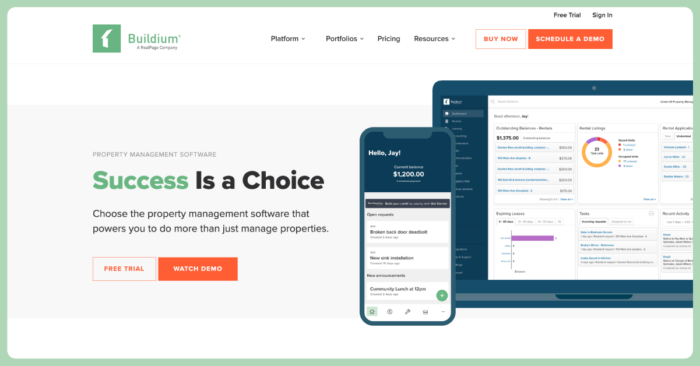
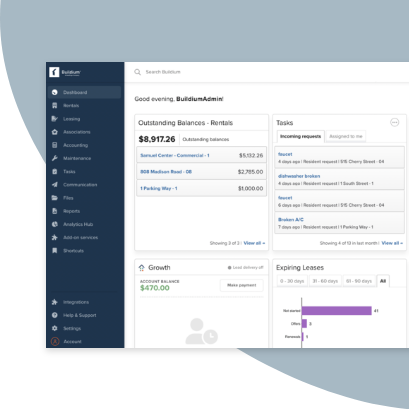
Buildium is a cloud-based property management platform designed for teams that manage properties on behalf of owners. It brings accounting, leasing, maintenance, payments, resident communication, owner reporting, and much more, into one system.
The platform supports residential rentals, community associations, and mixed portfolios, with additional automation, customization, and reporting tools available as operations become more complex.
Buildium Features
Buildium covers the range of tasks a management company handles day to day:
- Property accounting: Purpose-built double-entry accounting with bank reconciliation, financial reports, and 1099 e-Filing.
- Online payments: Residents pay online by EFT or card, with autopay and payment reminders.
- Maintenance: Work order and task management, vendor coordination, and property inspections.
- Leasing: Online applications, built-in tenant screening, and eSignatures in one flow.
- Resident Center: A resident portal for payments, requests, and messages.
- Automation and AI: Task automation, AI-assisted workflows and communications, and smart tools for repetitive tasks like bill scanning, bill scanning, reduce workload and make advanced features easy to use.
- Customization and integrations: Custom fields, roles, dashboards, partner integrations, and open API access give teams more flexibility as their processes grow.
Buildium Pricing
Buildium has three pricing tiers that scale with your portfolio size:
- Essential: Starting at $62 per month. Core accounting, maintenance, and leasing, plus standard and bulk reporting and the Buildium AI assistant.
- Growth: Starting at $192 per month. Everything in Essential plus more customization, reporting automation, enhanced tenant screening, and lower payment and eSignature costs.
- Premium: Starting at $400 per month. Everything in Growth plus the full AI and automation suite, an open API, free inspections and eSignatures, and the first year of incoming EFT at no cost.
Buildium also offers a 14-day free trial with no credit card required.
Innago: Free Software for Self-Managing Owners
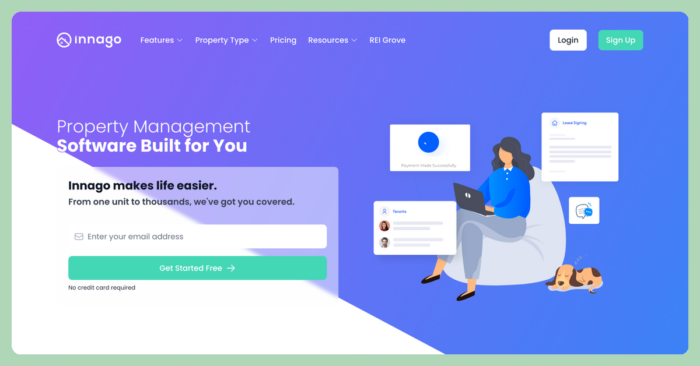
Innago is free property management software aimed at owners who manage their own rentals. It handles rent collection, lease management, tenant screening, and maintenance requests for small to mid-sized portfolios. Innago earns revenue from optional tenant-side costs, so owners pay nothing for access.
Innago Features
Innago covers the main workflows landlords and property managers need to manage rentals day to day.
- Online rent collection: Residents pay online, with automatic late notices and payment tracking.
- Tenant screening: Screening reports for applicants, with the cost typically paid by the applicant.
- Lease management: Create and send leases for eSignature, with state-specific lease templates.
- Maintenance requests: Residents submit requests online, and owners track and assign them.
- Listing and syndication: Post vacancies to listing sites to fill units.
- Financial reporting: Income and expense tracking with standard reports.
Innago Pricing
Innago is free for owners and property managers, with no subscription tiers, setup costs, or contracts.
- Free for owners: No monthly cost, setup cost, or contract, and no unit cap. Owners get full access to the platform.
- Tenant-paid online payments: Residents pay $2 per ACH payment or 2.99% for credit and debit cards. Owners can choose to absorb the ACH cost so residents pay nothing.
- Tenant-paid screening: Applicants pay $30 to $35 per screening (credit and criminal, plus eviction history), with income verification adding $10.
Buildium vs Innago: Feature-by-Feature Comparison
The two platforms overlap across many core property management tasks, but they differ in how deeply they support financial workflows, owner communication, automation, and integrations.
| Area | Buildium | Innago |
|---|---|---|
| Accounting & reporting | Double-entry property accounting, bank reconciliation, owner reporting | Income and expense tracking with standard financial reports |
| Leasing & screening | Listings, applications, screening, eSignatures, applicant management, renewals | Listings, applications, screening, eSignatures, lease templates, document storage |
| Maintenance | Work orders, vendor coordination, inspections, recurring tasks, staff tracking | Online maintenance requests, assignment, and tracking |
| Payments | Online EFT/card payments tied directly to resident ledgers and accounting | Online rent collection, recurring payments, reminders, and late notices |
| Automation & customization | Workflow automation, AI tools, custom fields, roles, dashboards | More straightforward built-in workflows with less configuration |
| Integrations | Marketplace ecosystem plus Open API access | More self-contained platform with a smaller integration footprint |
| Owner-facing tools | Dedicated owner portal and owner reporting | More focused on core rental management workflows |
Accounting and Reporting
Buildium goes deeper on accounting, with double-entry bookkeeping, bank reconciliation, financial reporting, and owner statements built into the platform. That gives property management companies a more complete system for tracking property finances and reporting back to clients.
Innago focuses more on income and expense tracking and standard financial reports. For simpler operations, that may cover the day-to-day need. Teams that need more advanced accounting controls or regular owner reporting may benefit from the additional depth in Buildium.
Online Payments
Rent collection works differently depending on how closely payments need to connect with the rest of the financial workflow.
In Buildium, payments post directly to resident ledgers and feed into the broader accounting system.
Innago supports online rent collection, recurring payments, reminders, and payment tracking, giving landlords and managers a centralized way to handle collections.
For teams that want rent activity tied closely to accounting and reporting, Buildium offers more financial integration. Innago keeps the payment process straightforward while covering the core collection workflow.
Maintenance
Maintenance needs can range from tracking a resident request to coordinating work across several vendors, properties, and staff members.
Innago lets residents submit requests online and gives managers tools to assign and track the work.
Buildium adds more structure around that process with work orders, vendor coordination, inspections, recurring tasks, and broader staff tracking.
That added structure becomes more useful when maintenance moves through multiple people or requires more oversight across a larger operation.
Leasing and Screening
Leasing is one of the areas where the two platforms overlap most.
Innago supports listings, applications, tenant screening, electronic lease signing, state-specific lease templates, and document storage, giving landlords and managers a connected way to move applicants into signed leases.
Buildium covers those same core steps, then adds more structure around applicant management, listing syndication, renewals, and the broader lead-to-lease workflow.
For teams comparing the two, the question is less about whether either platform can handle leasing and more about how much process control and coordination you need as leasing volume grows.
Communication
Resident communication is only part of the picture for companies managing properties on behalf of clients.
Buildium separates those audiences with a Resident Center and Owner Portal. Residents can handle payments, maintenance requests, and messages, while owners can access financial information and property updates without relying on staff to send everything manually.
Innago gives residents a central place to manage payments, requests, and communication. Its approach is more focused on the landlord-resident relationship, while Buildium adds a dedicated layer for owner communication and reporting.
Integrations
Integrations matter most when property management software needs to connect with accounting, payments, screening, maintenance, or other systems your team already uses.
Buildium has a broader integration ecosystem through its partner Marketplace, and adds open API access in ints Premium plan for teams that want to build custom connections or data workflows.
Innago takes a more self-contained approach. It includes many core functions within the platform, which can reduce the need for extra tools in simpler setups. For teams with a more established tech stack, Buildium offers more flexibility to connect systems and extend the platform.
Ease of Use and Support
Innago keeps the experience relatively straightforward, with a focused interface, help resources, and live support options that can work well for teams that want to get up and running without much setup.
Buildium has a broader feature set, so there is more to configure and learn. In return, users get access to onboarding resources, phone support on higher tiers, and additional guidance for more complex operations.
The better fit depends on how much structure your team needs. A simpler setup may favor Innago, while teams managing more involved workflows may value Buildium’s deeper onboarding and support options.
Pricing and Total Cost Compared
Buildium and Innago use very different pricing models.
Buildium charges a monthly subscription that starts at $62 and scales by plan and portfolio size.
Innago has no monthly software fee, with some transaction and screening costs paid by residents or applicants.
That makes Innago the lower-cost option upfront. But subscription price is only one part of the comparison. It also helps to look at the accounting, reporting, automation, integrations, and staff workflows your operation depends on.
For teams with simpler needs, Innago’s free model can be attractive. Property management companies with more complex financial and operational requirements may place more value on having those capabilities built into one platform.
Choosing Between Buildium and Innago
Start with the workflows that matter most to your operation. If your priority is keeping software costs low while covering rent collection, leasing, screening, maintenance, and basic financial tracking, Innago offers a broad set of tools without a monthly subscription.
Buildium becomes more relevant when accounting, owner reporting, automation, customization, and connected team workflows carry more weight in the decision. Those capabilities can matter more as operations involve additional staff, clients, properties, or reporting requirements.
The right choice comes down to which platform matches the way you work today and gives you enough room for what comes next.
Matching the Right Software to Your Business
Buildium and Innago take different approaches to the same core job. Innago keeps costs low while covering many everyday rental management tasks. Buildium adds more depth around accounting, owner reporting, automation, customization, and connected team workflows.
Use those differences to guide your decision. Start with the processes your team relies on most, then look at which platform can support them without adding unnecessary complexity or workarounds.
If Buildium matches the way your operation is growing, you can explore the platform with a 14-day free trial or sign up for a guided demo.
Frequently Asked Questions
Is Innago Really Free?
Yes, Innago is free for owners and property managers, with no monthly fee, setup cost, or contract. It earns revenue from tenant-paid costs instead, such as $2 per ACH payment and screening costs paid by applicants. Owners can choose to absorb the ACH cost so residents pay nothing.
How Much Does Buildium Cost per Month?
Buildium starts at $62 per month for the Essential plan, $192 per month for Growth, and $400 per month for Premium. Each price is a starting point that scales with your door count, and annual billing saves 10%. Payment processing and some add-ons have their own per-transaction costs.
Which Is Better for Accounting, Buildium or Innago?
Buildium offers full double-entry accounting, bank reconciliation, and owner statements built for managing properties on behalf of others. Innago covers income and expense tracking and syncs with QuickBooks Online, but it does not include a dedicated double-entry module. For owner reporting and month-end books, Buildium goes deeper.
Which Platform Fits My Portfolio Size?
Innago works well for owners managing a handful of their own units where the books stay simple. Buildium is built for management companies handling many doors across residential, association, and mixed portfolios. If you expect to add doors, Buildium is built to grow with you.
Is Innago Reputable?
Innago is an established property management software used by owners and small operators, and it reviews well on sites such as G2 and Capterra. It handles rent collection, leasing, screening, and maintenance requests for smaller portfolios. Its focus is simplicity, so it offers less accounting depth than a management company reporting to owners needs.
Buildium’s Commitment to Safe and Secure AI
At Buildium, we believe that AI should be a trusted extension of our platform–not a replacement for human judgement. Our approach to AI is grounded in transparency, education, and rigorous security standards. We deploy AI features with a clear focus: to automate routine tasks while preserving the integrity of sensitive decisions that require human oversight. Lumina AI is built for property managers who value efficiency, security, and trust. We’re not just innovating–we’re doing so responsibly.