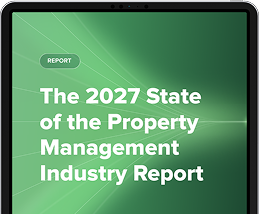



Eighty-three percent of property management companies are already using AI, planning to adopt it, or actively investigating it. That’s according to Buildium’s 2027 State of the Property Management Industry Report, which draws on annual surveys of nearly 3,000 property management professionals, rental property owners, and renters.
Start your 14-day Free Trial Today!
It takes just 30 seconds. No credit card required. Use sample data to see how Buildium handles your real-world tasks.
That changes the question about AI in property management. It’s no longer whether to use it. It’s whether you build around one connected system that gets more capable over time, or bolt five separate tools onto software that was never built to hold them together.
This post breaks down what the report found, what early adopters are doing differently, and how to keep up without overhauling your business. It pairs with our video on the same topic, so you can watch above or read on.
What the Report Found About AI Adoption
The adoption numbers are more specific than the headline. In Buildium’s survey, 33% of property management companies already use AI or automation, 18% plan to adopt it in the next year, and 32% are actively investigating it. Together, that’s the 83%. Those figures come from a May 2026 survey of nearly 1,000 property management professionals.
Growth is a big part of the reason. Seventy percent of companies plan to keep their teams the same size next year, even as 64% plan to expand their portfolios. As Robin Young, Buildium’s industry analyst, explains: “What companies are doing to bridge the gap between their growth plans and their team size is adopting AI and automation where it makes sense.”
From Single Tasks to Full Workflows
Most property managers started with AI in the obvious places, like drafting a message or summarizing a document. Resident communication and support leads at 48%, followed by internal operations and task management at 45%. Rent collection, maintenance triage, and leasing and renewals each land between 34% and 36%.
The early adopters in the report have moved past single tasks into full workflows: reporting, leasing, and maintenance coordination. The companies getting the most value treat AI as part of one operating system, not a collection of standalone tools. An AI that drafts a single message is a task tool. An AI that carries a maintenance request or lease renewal from start to finish is part of how your business runs.
Jonathan Coffey, Buildium’s VP of Product, names three workflows ready for agentic AI (AI that carries a job forward across several steps) today: lease renewal management, maintenance triage and dispatch, and first-response acknowledgment on inbound requests. The condition, he says: “Each one depends on having the conversation, the request, and the record in one place. Without that, AI automates a reply; with it, AI can carry the coordination.”
What Connected Looks Like in Practice
Standard Property Management in Buffalo, New York, a Buildium customer since 2015, manages 2,400 doors. Their team used to enter every listing twice, once in Buildium and again on their website, so any change meant updating both places. After connecting their site to Buildium through Buildium’s open API, units appear on the website when they’re listed and come down automatically when they’re leased.
Greg Suffoletto, owner of Standard Property Management, says in the Buildium customer story: “We’re twice as efficient as we were before the open API.”
That’s a leasing example, not an AI one. But the principle carries over. When your systems share one record, there’s less duplicate work for any tool, AI included, to work around.
The Bolt-On Trap
When an AI trend catches your eye, it’s tempting to add a tool: a chatbot for messages, a dispatch app for maintenance, a separate tool for reports. Each can work fine on its own. The trouble starts when your team becomes the connection between them, copying updates from one system to another.
The report calls this the biggest technology gap, and it isn’t access to tools. It’s getting a team to use one system the same way every time. Missed updates and workarounds create duplicate work, and statuses end up living in someone’s head. The survey points the same way: 63% of property managers named adopting new tools, or better using the ones they already have, as their top cost-control tactic this year.
Young’s take: “Heading into 2027, it’s not just about whether your teams have access to technology at this point. It’s about how consistently it’s being used.” She suggests looking for places where work is duplicated or updates are missed because information lives in someone’s head rather than in your system. One of the biggest offenders she hears about is side conversations, where residents, owners, and vendors get looped in outside your software.
The report’s fix is simple. Route resident, owner, and vendor communication through your property management software instead of side texts and calls, so anyone on your team can see a job’s status without asking around.
What Owners and Residents Notice
Disconnected systems don’t just slow your team down. Owners and residents feel them too. When maintenance updates and messages live in separate places, people end up asking for information that should already be visible.
The numbers show why that matters. Rental owners named speed of communication as the top way they judge a property manager, at 43%. On the resident side, 84% of renters expect a response within 24 hours, and 61% expect one the same day. Renters who are satisfied with communication are 58% more likely to renew.
Showing status before anyone has to ask is much easier when everything lives in one system.
The Math of Growing Without Hiring
Adding people isn’t the only way to handle growth, and for many companies it isn’t the plan. In the survey, 48% said they’re protecting service quality and profitability by using technology to increase productivity instead of hiring. That was the most common response among the approaches the survey asked about.
Young sees the same pattern in the numbers: “Companies are continuing to grow, but they’re not necessarily growing their teams to accommodate that expansion. They’re turning to technology.”
None of this means taking people out of the picture. The report recommends keeping a person involved in anything customer-facing, financial, or compliance-sensitive, so your team can spend its time on judgment calls, relationships, and strategic decisions.
How Buildium Builds AI into One System
AI does its best work inside comprehensive software built for property managers. Buildium’s built-in AI, runs inside the platform that already holds your leases, maintenance requests, and owner and resident communication. Because the conversation, the request, and the record sit in one place, the AI doesn’t have to guess at context.
Here’s what that looks like in four everyday workflows:
- Leasing. Picture 15 units with applications in, 30 applicants to work through, and a group tour at noon. Done by hand, drafting and executing the leases, delisting each unit, and updating every applicant’s status adds up to roughly two and a half hours. The Buildium’s Leasing Agent creates and executes the leases, delists the units, and changes the status of the applicants you don’t move forward with.
- Invoices. AI Bill Scan reads up to 10 invoice files at once and pulls out the dates, vendor details, allocations, and line items. It then creates draft bills ready for you to review, approve, and pay. Vendors can also email invoices to a dedicated inbox, and each attachment becomes a draft bill.
- Maintenance. The Maintenance Agent closes a work order once every bill on it has been paid, so finished jobs don’t linger on someone’s list. It works because the work order and the bills live in the same system.
- Communication. AI writing tools draft emails, texts, announcements, and templates, with options to adjust tone or translate. Faster drafts help you meet resident expectations on response time.
You choose which AI capabilities to turn on in AI Settings, so you can start with one workflow and add more as your team gets comfortable.
If you want something specific to your business, Buildium’s open API lets you connect the rest.
See Buildium’s AI in Action
Ready to see what connected AI looks like for your portfolio? Schedule a demo to watch Lumina AI work across leasing, bills, and maintenance. Or try Buildium free for 14 days, no credit card required.
Frequently Asked Questions
What is agentic AI in property management?
Most AI tools respond to a single prompt, like drafting a message or summarizing a document. Agentic AI carries a job forward across multiple steps with less hands-on direction, such as moving a rental application through screening, approval, and lease signing. A person stays in the loop for anything customer-facing, financial, or compliance-sensitive.
Where should I start with AI in property management?
Start where work gets stuck. Look for the handoffs that need the most follow-up, then apply AI to the repetitive, low-risk pieces first. Focus on improving workflows, not just individual tools. For many companies, that means resident communication or maintenance requests, which are also among the most common uses of AI today.
Will AI take over my team’s work?
The report points the other way. Letting AI absorb repetitive work frees your team for judgment calls and relationships. Coffey’s advice is to rank recurring tasks by hours consumed, automate from the top of that list, and keep the judgment calls with your team.
Keeping Up with AI in Property Management
The early adopters in this year’s report share one habit: they build around one connected system instead of stacking separate tools. That means standardizing where work happens, starting with the handoffs that stall, and keeping people involved where judgment matters. Whether you manage 50 doors or 500, you can start small and build from there.
AI in property management does more when it can see the full picture, and that’s how Buildium is built. Read more on AI and Automation