
Tennessee Rental Market Trends in 2026
In recent years, Tennessee has emerged as a hotspot for residents and investors alike. The state’s appeal lies in a powerful combination of economic vitality, population growth, and relative affordability. Tennessee’s economy has diversified significantly, with strong job creation in healthcare, logistics, technology, and manufacturing. And many of its cities have become regional hubs for innovation and employment, attracting a younger workforce in search of opportunity and quality of life.
With its business-friendly environment, booming job market, and strong rental demand, Tennessee presents numerous opportunities for investors seeking strong returns on investment. But with large influxes of supply in certain places, it’s important to know which Tennessee rental markets present the strongest opportunities under current conditions.
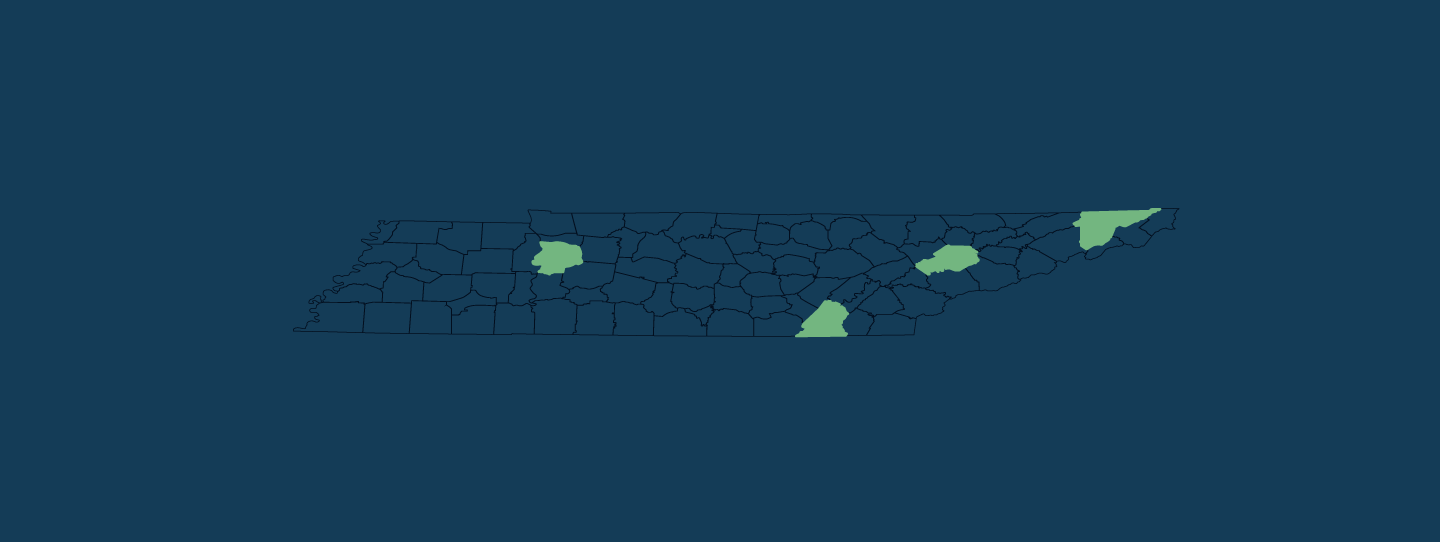
In this post, we’ll explore five cities that stand out for their investment prospects in 2026—from well-known hubs like Nashville and Chattanooga to rising stars like Johnson City and Kingsport. We’ll share rental market statistics for each city, including inventory growth, rent growth, vacancy rates, cap rates, and home value appreciation. We’ll also highlight economic and demographic trends in each market.
Top 5 Rental Markets in Tennessee for 2026
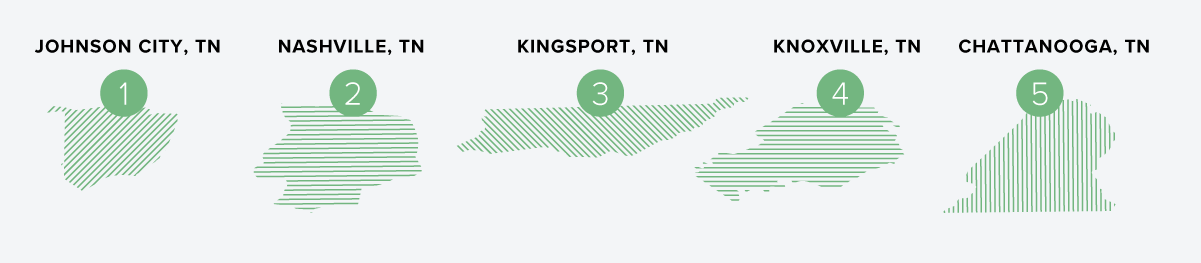
Without further ado, here are 5 Tennessee rental markets where our research indicates growth opportunities lie in 2026.
Market #1: Johnson City, TN
Johnson City is Tennessee’s eighth-most populous city, with 212,561 residents living in its metro area. Its population has been growing steadily since the city’s founding in 1856. Johnson City was named for a railroad station (Johnson’s Depot) that was a hub for multiple rail systems throughout the nineteenth and twentieth centuries. Today, one of those train lines has been transformed into the popular Tweetsie Trail.
Surrounded by the Blue Ridge Mountains, Johnson City is located in eastern Tennessee. It’s relatively close to the borders of North Carolina and Virginia; and parts of Kentucky, South Carolina, and Georgia are also accessible for day trips, giving Johnson City a central location within the region. Residents are able to enjoy outdoor activities in parks like Tannery Knobs, Founders Park, and King Commons. Cultural attractions include the Tipton-Haynes State Historic Site, Reece Museum, Johnson City Community Theatre, and the Johnson City Public Library.
To its residents, Johnson City is known for its friendly, small-town atmosphere, its relative affordability, and its strong local economy. Johnson City’s top employers are spread across the healthcare, education, and government sectors, including Ballad Health, East Tennessee State University, James H. Quillen VA Medical Center, Mountain States Health Alliance, Johnson City’s local government, and the Washington County School System.
Buildium’s list of up-and-coming real estate markets in 2026 ranked Johnson City in position #34 due to its strong rent growth, vacancy rates, cap rates, and economic growth over the last few years. The city’s affordability and convenience to other markets makes it a great spot for investors and property managers to get their foot in the door in Tennessee in 2026.
Johnson City, TN Rental Market Statistics
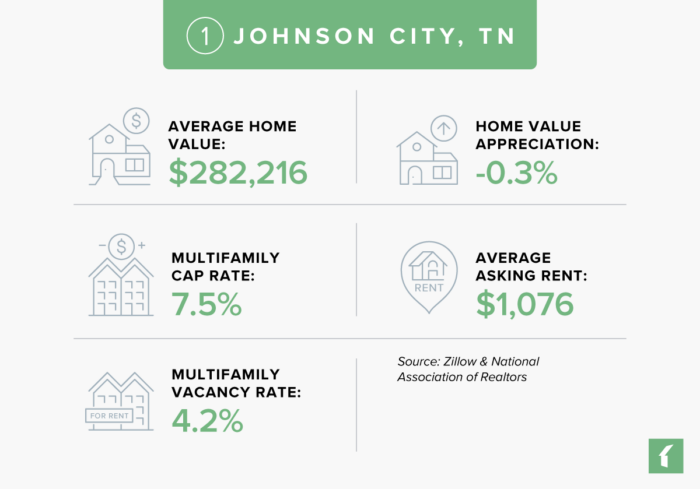
- Rental Inventory (Q2-’24): 7,904
- Units Added Since Q2-’23: +180
- Asking Rent Growth Since Q2-’23: 6.3%
- Asking Rent (Q2-’24): $1,076
- Effective Rent (Q2-’24): $1,070
- Multifamily Vacancy Rate (Q2-’24): 4.2%
- Multifamily Cap Rate (Q2-’24): 7.5%
Source: National Association of Realtors
Johnson City, TN Housing Market Statistics
- Average Home Value (Q4-’25): $282,216
- Home Value Appreciation Since Q4-’24: -0.3%
Source: Zillow
Johnson City, TN Economic Statistics
- Population Growth (2024): 0.3%
- GDP Growth (2023): 4.2%
- Job Growth (Q3-’25): -0.1%
Source: National Association of Realtors
Lists That Mention Johnson City, TN
- Best Places to Live (U.S. News): #181
Market #2: Nashville, TN
Nashville is the most populous city in Tennessee, with 2,104,235 residents calling its metro area home. Often referred to as a boomtown in recent years, Nashville’s metro area population has surged by 81% since 1990 as people have been drawn in by its economic growth and cultural appeal, as well as its affordability in comparison with coastal cities.
Known as Music City, Nashville’s deep-rooted connections to the music industry draw many residents and visitors each year to attractions like the Tennessee Performing Arts Center, the Country Music Hall of Fame and Museum, and the Grand Ole Opry. Visitors also enjoy Nashville’s many arts centers and museums, including the Frist Center for the Visual Arts, the Cheekwood Botanical Garden and Museum of Art, and the Tennessee State Museum. The CMA Music Festival, the Tennessee State Fair, the Nashville Film Festival, and countless other events also bring many visitors to Nashville each year.
In addition to music, the healthcare, education, and automotive industries are important to Nashville’s economy. Top employers in the city include Vanderbilt University and its medical center, the local, state, and federal governments, HCA Healthcare, Metropolitan Nashville Public Schools, Ascension Saint Thomas, and Kroger Co. Fortune 500 companies that have offices in Nashville include Nissan, Deloitte, Dell, BNY Mellon, Bridgestone, Philips, Dollar General, and Ernst & Young. In addition to Vanderbilt, there are a number of other higher education institutions in the city, such as Tennessee State University, Belmont University, and Fisk University.
Nashville’s location along the Cumberland River made it a key trading post throughout its early history. Today, its proximity to interstate highways, major rail lines, and the Nashville International Airport make it a prominent transportation hub, as well as a logistics and distribution center for the region.
Nashville wasn’t on Buildium’s list of up-and-coming real estate markets due to its declining rent growth and elevated vacancy rates over the last few years—a result of intense supply pressure over the last few years. However, construction activity is slowing, and rental demand remains strong—plus, Nashville was ranked in position #6 on PwC and the Urban Land Institute’s list of markets to watch in 2026 in their widely respected Emerging Trends in Real Estate report. So, if you or your clients are looking to expand into a thriving secondary market in 2026, Nashville could be a strong contender if you find a property that presents strong ROI potential.
Nashville, TN Rental Market Statistics
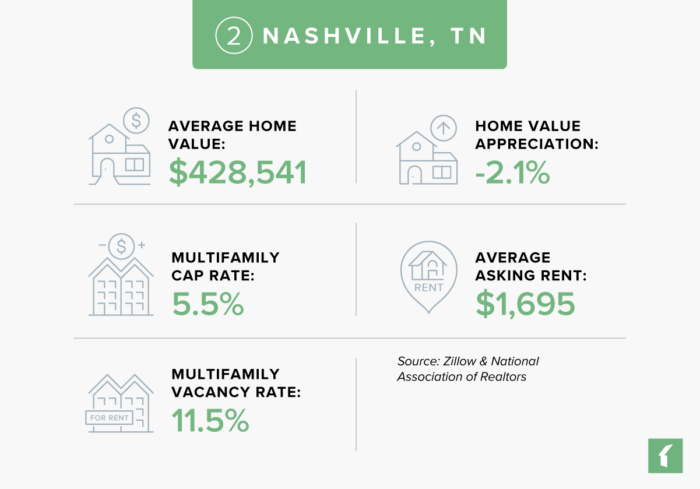
- Rental Inventory (Q3-’25): 186,309
- Units Added Since Q3-’24: +2,852
- Asking Rent Growth Since Q3-’24: -1.3%
- Asking Rent (Q3-’25): $1,695
- Effective Rent (Q3-’25): $1,658
- Multifamily Vacancy Rate (Q3-’25): 11.5%
- Multifamily Cap Rate (Q3-’25): 5.5%
Source: National Association of Realtors
Nashville, TN Housing Market Statistics
- Average Home Value (Q4-’25): $428,541
- Home Value Appreciation Since Q4-’24: -2.1%
Source: Zillow
Nashville, TN Economic Statistics
- Population Growth (2025): 2.3%
- GDP Growth (2023): 3.1%
- Job Growth (Q3-’25): 1.2%
Source: National Association of Realtors
Lists That Mention Nashville, TN
- Markets to Watch (PwC/ULI): #6
- Best Places to Live (U.S. News): #228
- Best Real Estate Markets (WalletHub): #8
Market #3: Kingsport, TN
Kingsport is located in the northeastern corner of Tennessee, just across the border from Virginia. The metro area has 312,490 residents. Together with Johnson City and Bristol, Kingsport is a part of the Tri-Cities region (also referred to as the Mountain Empire) that includes communities in Northeast Tennessee and Southwest Virginia.
Kingsport’s location along the Holston River made it an ideal shipping port for goods on their way to Knoxville throughout the nineteenth century. For more than a hundred years, Kingsport’s most significant employer has been Eastman Chemical Company, an S&P 500 business whose headquarters employs 6,500 workers here. Other top employers include Partner Industrial, Ballad Health Holston Valley Hospital, and Kingsport City Schools. Three higher education institutions also have branches in Kingsport: East Tennessee State University, Lincoln Memorial University, and Northeast State Community College.
Located in the heart of the Appalachian Mountains, Kingsport residents can enjoy hiking, fishing, camping, boating, and more. Cultural attractions include Bays Mountain Park & Planetarium, Netherland Inn Museum, Allandale Mansion, Exchange Place, and Kingsport Carousel & Park. Residents and visitors can also see performances by the Symphony of the Mountains and Kingsport Ballet, as well as exhibits put on by the Kingsport Art Guild. Sports fans can catch a baseball game at Hunter Wright Stadium played by the Kingsport Axmen, part of the Appalachian League.
Kingsport didn’t quite make it onto Buildium’s list of up-and-coming real estate markets in 2026, but the market continues to show moderately strong rent growth, vacancy rates, and cap rates. As the most affordable Tennessee real estate market on our list, Kingsport may be worth a look for rental investors and property managers looking to grow their portfolios in the state this year.
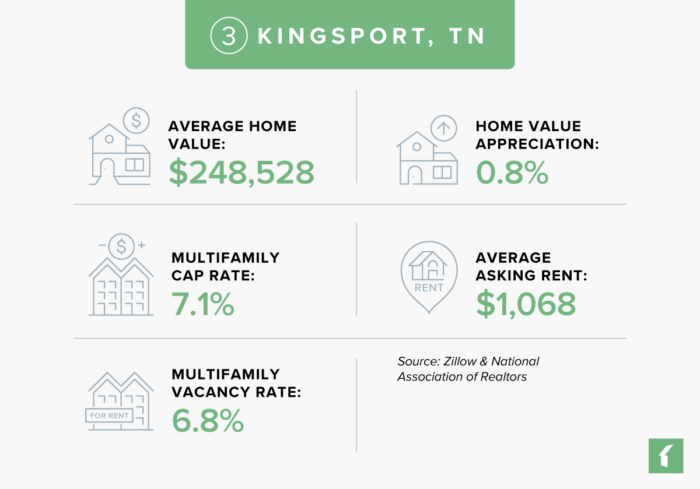
Kingsport, TN Rental Market Statistics
- Rental Inventory (Q2-’24): 6,036
- Units Added Since Q2-’23: +41
- Asking Rent Growth Since Q2-’23: 4.1%
- Asking Rent (Q2-’24): $1,068
- Effective Rent (Q2-’24): $1,062
- Multifamily Vacancy Rate (Q2-’24): 6.8%
- Multifamily Cap Rate (Q2-’24): 7.1%
Source: National Association of Realtors
Kingsport, TN Housing Market Statistics
- Average Home Value (Q4-’25): $248,528
- Home Value Appreciation Since Q4-’24: 0.8%
Source: Zillow
Kingsport, TN Economic Statistics
- Population Growth (2025): 0.6%
- GDP Growth (2023): 0.5%
- Job Growth (Q3-’25): 1.0%
Source: National Association of Realtors
Lists That Mention Kingsport, TN
- Best Places to Live (U.S. News): #146
Market #4: Knoxville, TN
Located in eastern Tennessee, the Knoxville metro area’s 947,017 residents make it the third-most populous city in the state. Founded in 1791, Knoxville’s economy and population have seen multiple upswings over the centuries, including the railroad’s connection to the city in 1855; the establishment of iron and textile industries following the Civil War; and the revitalization of the city in line with the 1982 World’s Fair. In recent years, urban renewal projects and economic diversification have played crucial roles in the city’s ongoing development.
Knoxville has a diverse economic landscape, with employers across the education, healthcare, energy, retail, and entertainment sectors. Top employers include the University of Tennessee, Covenant Health, the Tennessee Valley Authority, Dollywood, Roark Capital Group, Food City, and the state of Tennessee.
The Great Smoky Mountains and Cumberland Mountains are close by, providing residents and visitors with endless opportunities for hiking, fishing, camping, and more. Cultural attractions include the Knoxville Museum of Art, the Bijou Theatre, the Knoxville Symphony Orchestra, and the historic site James White’s Fort. Residents also enjoy the city’s youthful energy and rich culture stemming from the University of Tennessee, with the Ewing Gallery of Art + Architecture and Hodges Library holding frequent events. There are also numerous events held in Knoxville each year, including the Big Ears music festival and Dogwood Arts Festival.
Knoxville wasn’t selected for Buildium’s list of up-and-coming real estate markets in 2026 due to its flagging rent growth and vacancy rates over the past year. However, its economic growth and its affordability in comparison with much of the U.S. make Knoxville a compelling choice for investors and property managers looking to expand within Tennessee.

Knoxville, TN Rental Market Statistics
- Rental Inventory (Q3-’25): 46,805
- Units Added Since Q3-’24: +409
- Asking Rent Growth Since Q3-’24: -0.7%
- Asking Rent (Q3-’25): $1,478
- Effective Rent (Q3-’25): $1,458
- Multifamily Vacancy Rate (Q3-’25): 8.5%
- Multifamily Cap Rate (Q3-’25): 6.3%
Source: National Association of Realtors
Knoxville, TN Housing Market Statistics
- Average Home Value (Q4-’25): $359,252
- Home Value Appreciation Since Q4-’24: 0.7%
Source: Zillow
Knoxville, TN Economic Statistics
- Population Growth (2025): 1.1%
- GDP Growth (2023): 2.0%
- Job Growth (Q3-’25): 1.3%
Source: National Association of Realtors
Lists That Mention Knoxville, TN
Market #5: Chattanooga, TN
Chattanooga is located in southeastern Tennessee along the state’s border with Georgia. 580,353 people live in its metro area, making it the fourth-most populous MSA in Tennessee. Chattanooga has been a transportation hub for the region since its establishment in 1839, with multiple interstates and rail lines converging here. In addition, Chattanooga’s location along the Tennessee River has made it a hub for commerce throughout its history.
Chattanooga was known for its production of iron, steel, and other industrial goods during the first half of the twentieth century. As with other Rust Belt Cities, it struggled with deindustrialization, layoffs, and population loss during the 1970s and ‘80s. Since then, Chattanooga has undergone significant revitalization, including measures to restore historic buildings, develop green spaces, and improve air quality, all of which have helped to attract new businesses and residents to the city.
Chattanooga’s economy is significantly more diverse now than it once was, with a mix of traditional manufacturing and emerging industries. Top employers include Erlanger Health System, BlueCross BlueShield, Hamilton County Schools, the Tennessee Valley Authority, McKee Foods Corp, Unum, Volkswagen, and CHI Memorial Hospital. Higher education institutions in Chattanooga include the University of Tennessee at Chattanooga and Chattanooga State Community College.
Residents and visitors to Chattanooga are drawn to the city’s cultural attractions, such as the Hunter Museum of American Art, Tennessee Aquarium, Chattanooga Symphony & Opera, Creative Discovery Museum, Chattanooga Theatre Centre, and Songbirds Guitar Museum. The Bluff View Art District’s galleries, cafes, and gardens are a great place to enjoy the local art scene. In addition, the Riverbend Festival draws music lovers to the city each year.
Chattanooga didn’t make it onto Buildium’s list of up-and-coming real estate markets in 2026 because of its negative rent growth and high vacancy rate over the last two years. However, the city’s healthy real estate market and population growth makes this a potential pick for investors and property managers looking to expand into one of Tennessee’s largest cities at an affordable price point.
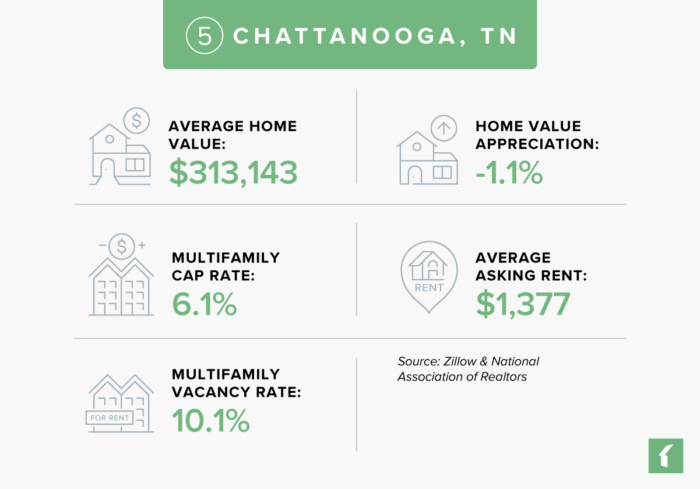
Chattanooga, TN Rental Market Statistics
- Rental Inventory (Q3-’25): 30,410
- Units Added Since Q3-’24: +0
- Asking Rent Growth Since Q3-’24: -1.5%
- Asking Rent (Q3-’25): $1,377
- Effective Rent (Q3-’25): $1,352
- Multifamily Vacancy Rate (Q3-’25): 10.1%
- Multifamily Cap Rate (Q3-’25): 6.1%
Source: National Association of Realtors
Chattanooga, TN Housing Market Statistics
- Average Home Value (Q4-’25): $313,143
- Home Value Appreciation Since Q4-’24: -1.1%
Source: Zillow
Chattanooga, TN Economic Statistics
- Population Growth (2025): 1.4%
- GDP Growth (2023): -0.1%
- Job Growth (Q3-’25): 0.2%
Source: National Association of Realtors
Lists That Mention Chattanooga, TN
- Markets to Watch (PwC/ULI): #65
How Do We Identify the Best Rental Markets in Tennessee?
We use the following sources to help us ascertain the best rental markets in the U.S. across five different categories.
Industry Indicators
Measures of opportunity for rental property investors and property managers:
- Markets with the best overall real estate investment prospects, as measured by PwC and the Urban Land Institute
- Housing markets with emerging investment opportunities, as measured by the Wall Street Journal and Realtor.com
- Markets with a greater number of renters relative to homeowners, as measured by the National Association of Realtors
- Markets with a high rate of renter household formation, as measured by the National Association of Realtors
Housing Indicators
Measures of property prices and rent growth:
- Markets with the highest growth in asking rents, as measured by the National Association of Realtors
- Markets with the lowest rental property vacancy rate, as measured by the National Association of Realtors
- Markets with the highest rental property cap rates, as measured by the National Association of Realtors
- Markets with the most home price appreciation, as measured by the National Association of Realtors
- Markets with affordable monthly mortgage payments relative to income, as measured by the National Association of Realtors
Economic and Job Market Indicators
Measures of employment growth:
- Markets with the lowest unemployment rates, as measured by the National Association of Realtors
- Markets with the most employment growth, as measured by the National Association of Realtors
- Markets with the most GDP growth, as measured by the National Association of Realtors
- States with the most economic activity, as measured by the National Association of Realtors
Demographic Indicators
Measures of population growth:
- Markets with the greatest population growth, as measured by the National Association of Realtors
- The fastest-growing real estate markets, as measured by U.S. News
- The best places to live, based on analyses of quality of life and desirability, as measured by U.S. News
Climate Indicators
Measures of climate vulnerability:
- Markets with the lowest risk of natural disasters and extreme conditions, as measured by the Federal Emergency Management Agency
60 Up-and-Coming Real Estate Markets in 2025
In Buildium’s annual Up-and-Coming Real Estate Markets list, we analyzed 175 metro areas across the U.S. to determine which cities show promise for rental investors and property managers in the year ahead. View the full list of emerging markets we’ve identified across the country.
Read more on Industry Research